

Incident Report
Our Incident Report shows the latest incident trends KPIs for your Teams and Organization, comparing them with the previous period. The report is available on Team and Organization Level.Team level
The Incident Report is visible to all Members of the related Team. If the Team belongs to an Organization, all Users with Organization Roles have access, too.
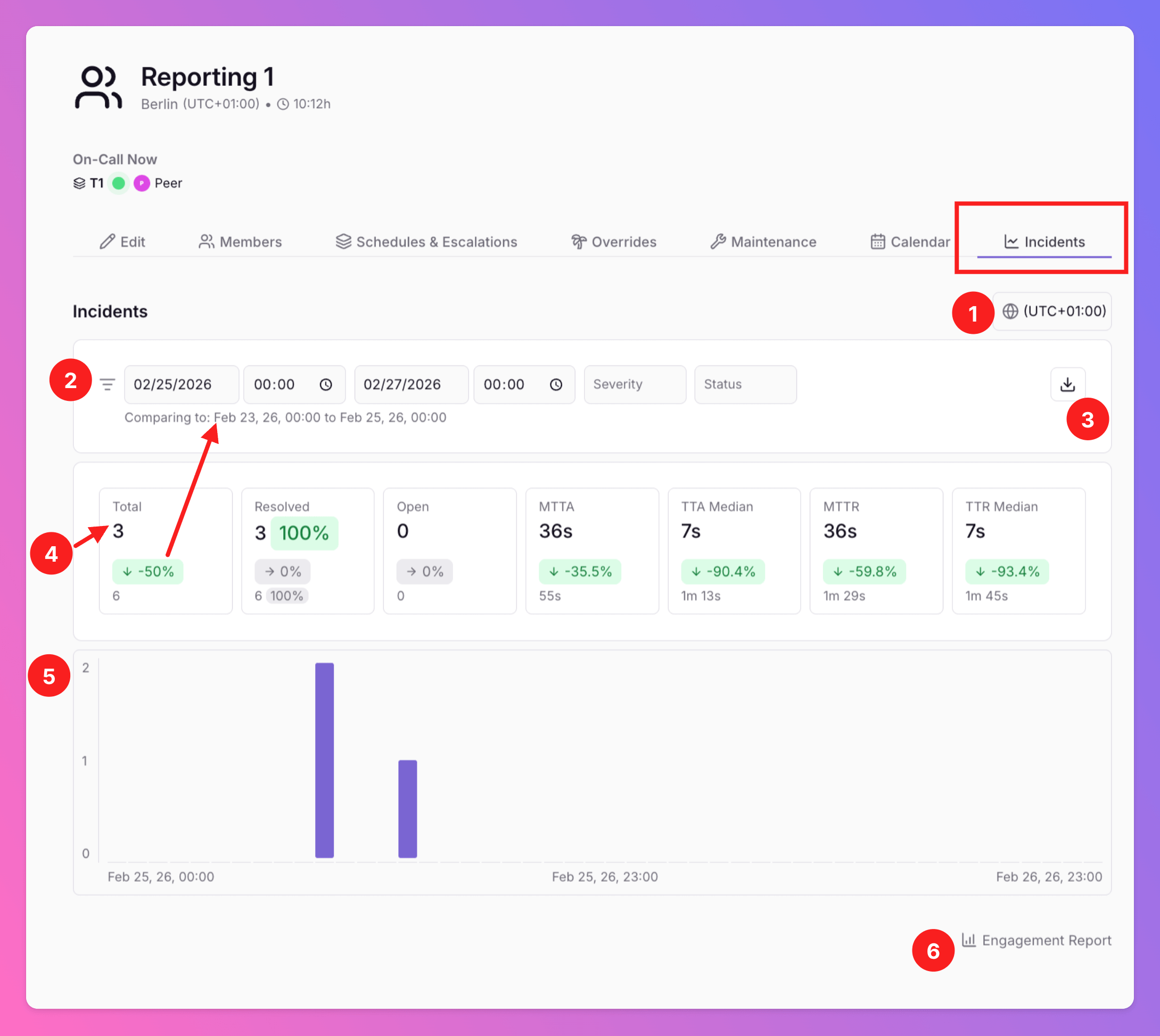
Incidents tab of your Team.
- Select the Timezone of the Report. Per default, the report shows all times in your Team’s timezone.
- Add filter criteria
- Per default, the report shows the last 7 days and compares them with the previous 7 days. You can adjust this time interval, anytime.
- Additionally, you can filter for Incident
SeverityorStatus.
- Download the Report as .csv based on your current filters.
- Your Team’s incident KPIs, comparing the current time interval with the previous.
- Total: Total Number of Incidents
- Resolved: Number of Incidents that are resolved, also relative (in %) to the number of Total incidents.
- MTTA: Mean Time to Acknowledge, the average time it took your team to acknowledge new incidents.
- TTA Median: It’s the middle amount of time it took your team to acknowledge an incident. Half the cases happen faster than this time, and half happen slower.
- MTTR: Mean Time to Resolution, the average time it took your team to resolve new incidents.
- TTR Median: It’s the middle amount of time it took your team to resolve an incident. Half the cases happen faster than this time, and half happen slower.
- Noise: Percentage of incidents that were flagged as noise.
- The graph showing the amount of incidents per time interval matching your filter criteria.
- Link to the Engagement Report.
Integration Level
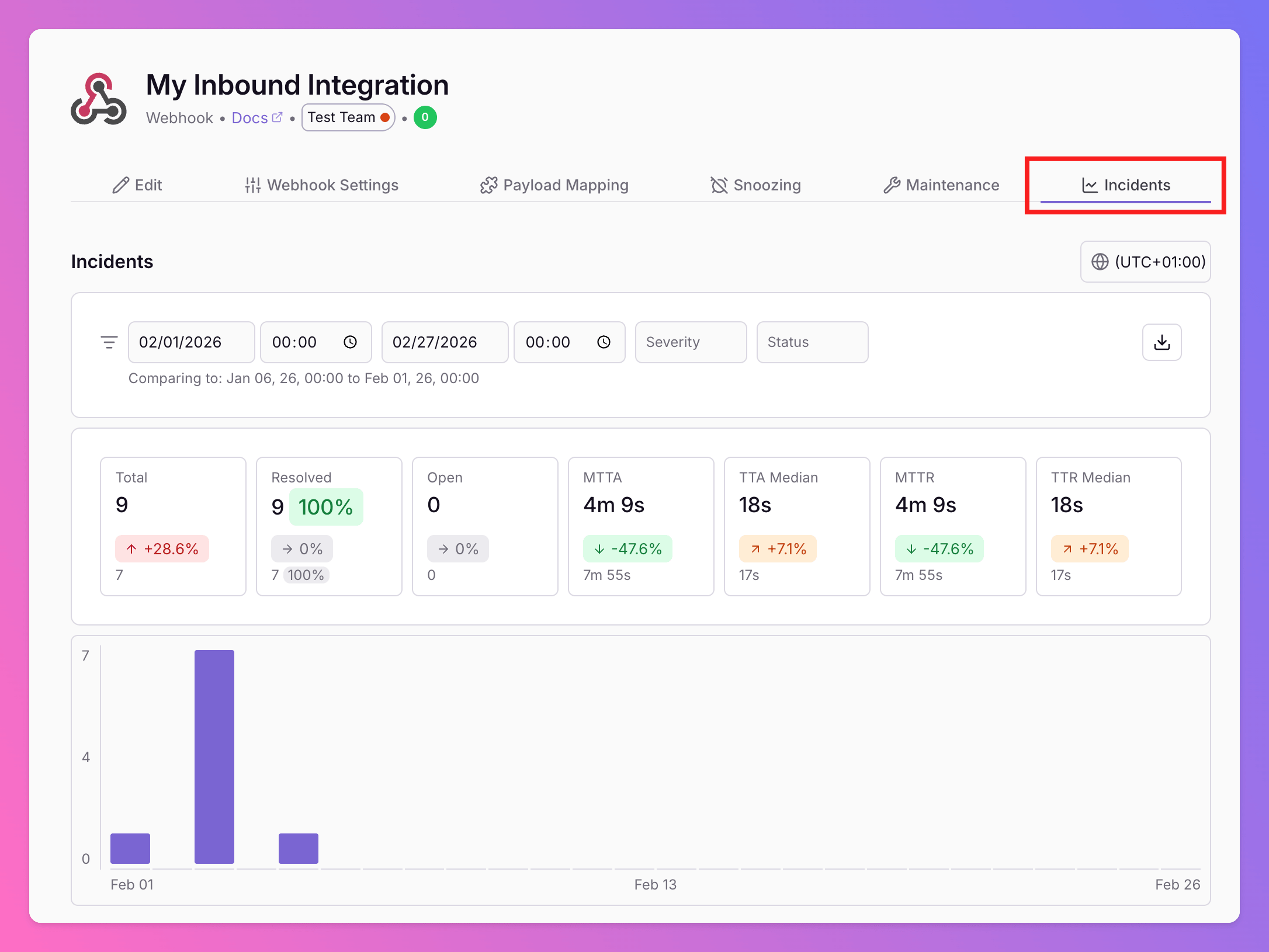
The Incident Report is visible to Team Administrators, Organization Administrators and Organization Owners.
Organization Level
This feature is only available for Organizations, which are part of Pro and Enterprise plans.
The Incident Report is visible to Organization Administrators and Organization Owners.
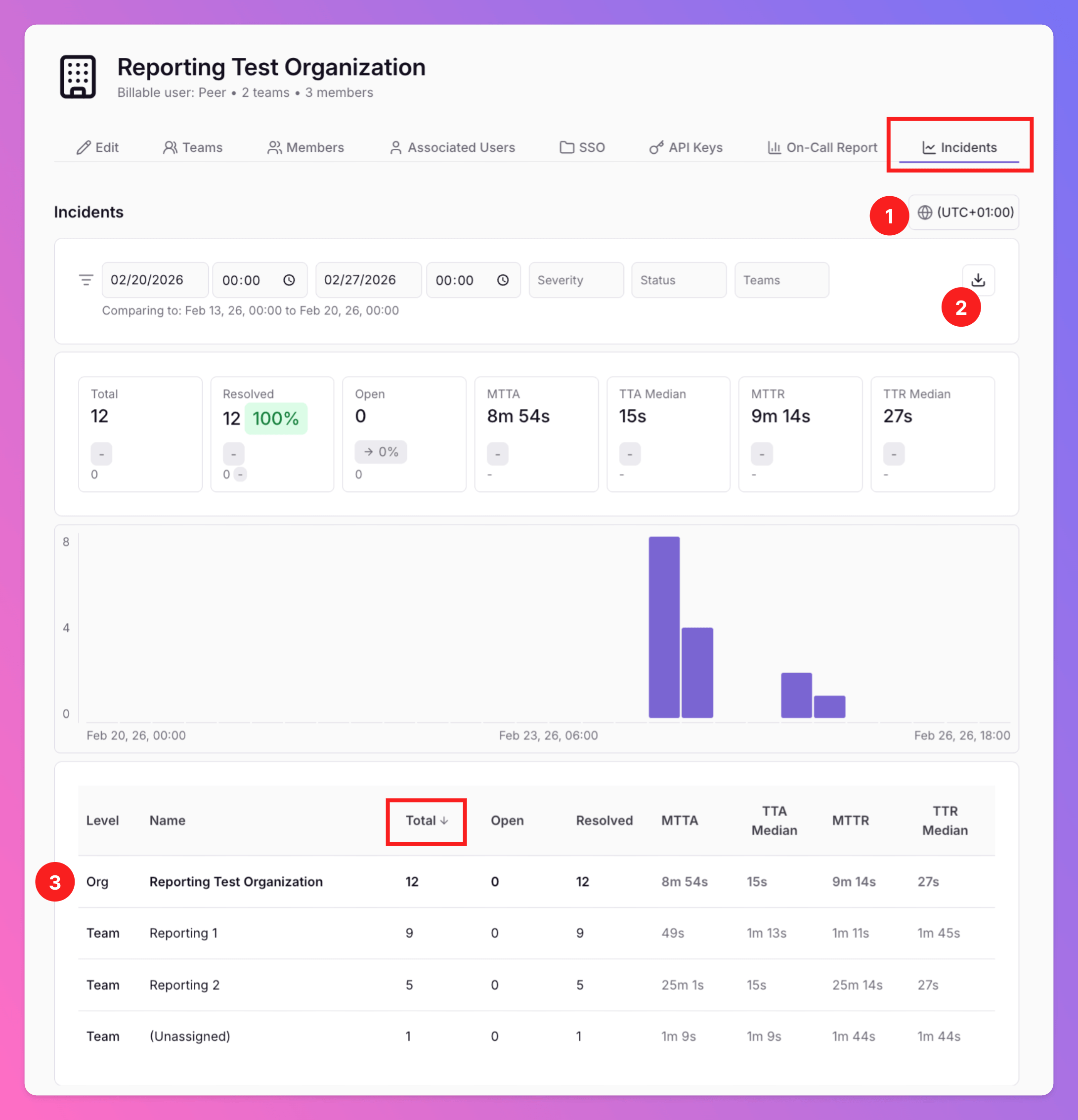
Incidents within your Organization.
In general, the report works the same as the Team Incident Report.
- Select the timezone for the report. Per default, it’s your local timezone.
- Download the Report as .csv based on your current filters. The Organization Report has the same filters and default settings as the Team Report, plus you can filter for Teams.
- Below the graph, you can find a table showing all relevant KPIs on Org Level and per Team.
- You can sort the table by any KPI in ascending or descending order by clicking on the column header. This allows you, for example, to quickly identify which team has the most incidents or the highest MTTA.
- The Org Level Row always stays on top.
On-Call Report
This feature is only available for Organizations, which are part of Pro and Enterprise plans.
The On-Call Report is visible to Organization Administrators and Organization Owners
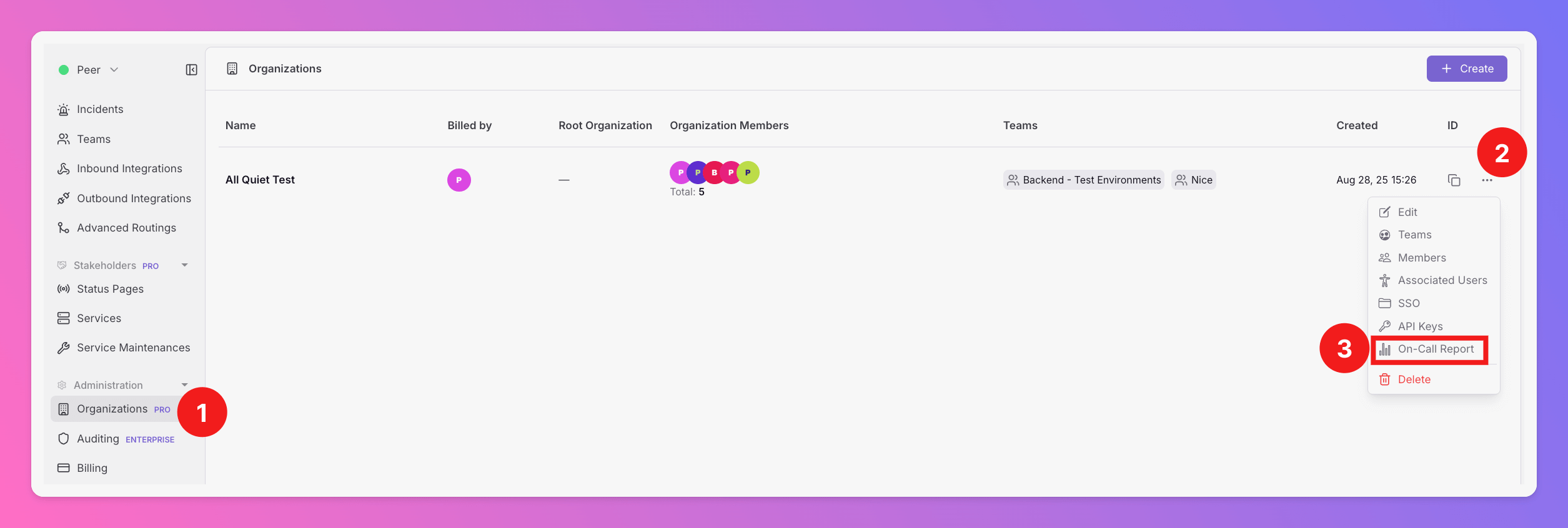
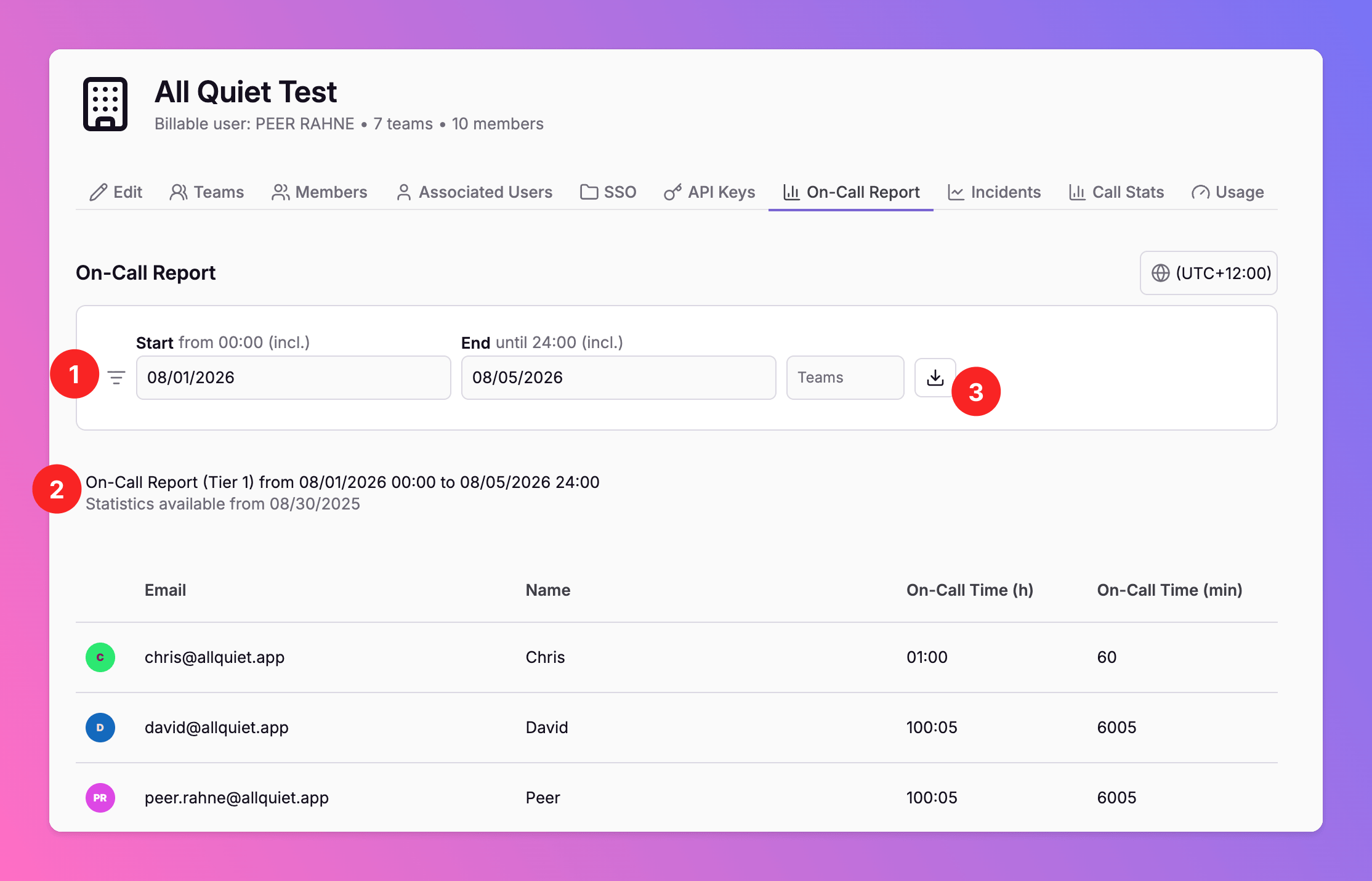
- In the Web App, open
Organizations. - Select the desired Organization and open the 3-dot menu.
- Click on the
On-Call Reportbutton.
- The Report is available on-demand with flexible date selection and per default features all on-call times of the current month. You can also filter for Teams of your organization and only export on-call times from these teams. The timezone can be used to further fine tune the observed interval. If you have users living in different timezones, this feature helps to determine their actual on-call times for e.g. the month according to their timezone. This can be pretty important for payroll purposes.
- You can see the on-call times of your organization’s users for the selected interval. Note that only Tier 1 and Tier 1 fill-up times are currently represented. If a user is on-call in 2 different teams of one organization at the same time, the time is still only counted once.
- Download button: Download a .csv of the on-call times for the selected time interval.
Engagement Report
The Engagement Report is visible to all Members of the related Team. If the Team belongs to an Organization, all Users with Organization Roles have access, too.
Teams > Reports section in the Web App with flexible date selection, this feature also arrives on a weekly basis in your inbox.
The report is created for each team separately.
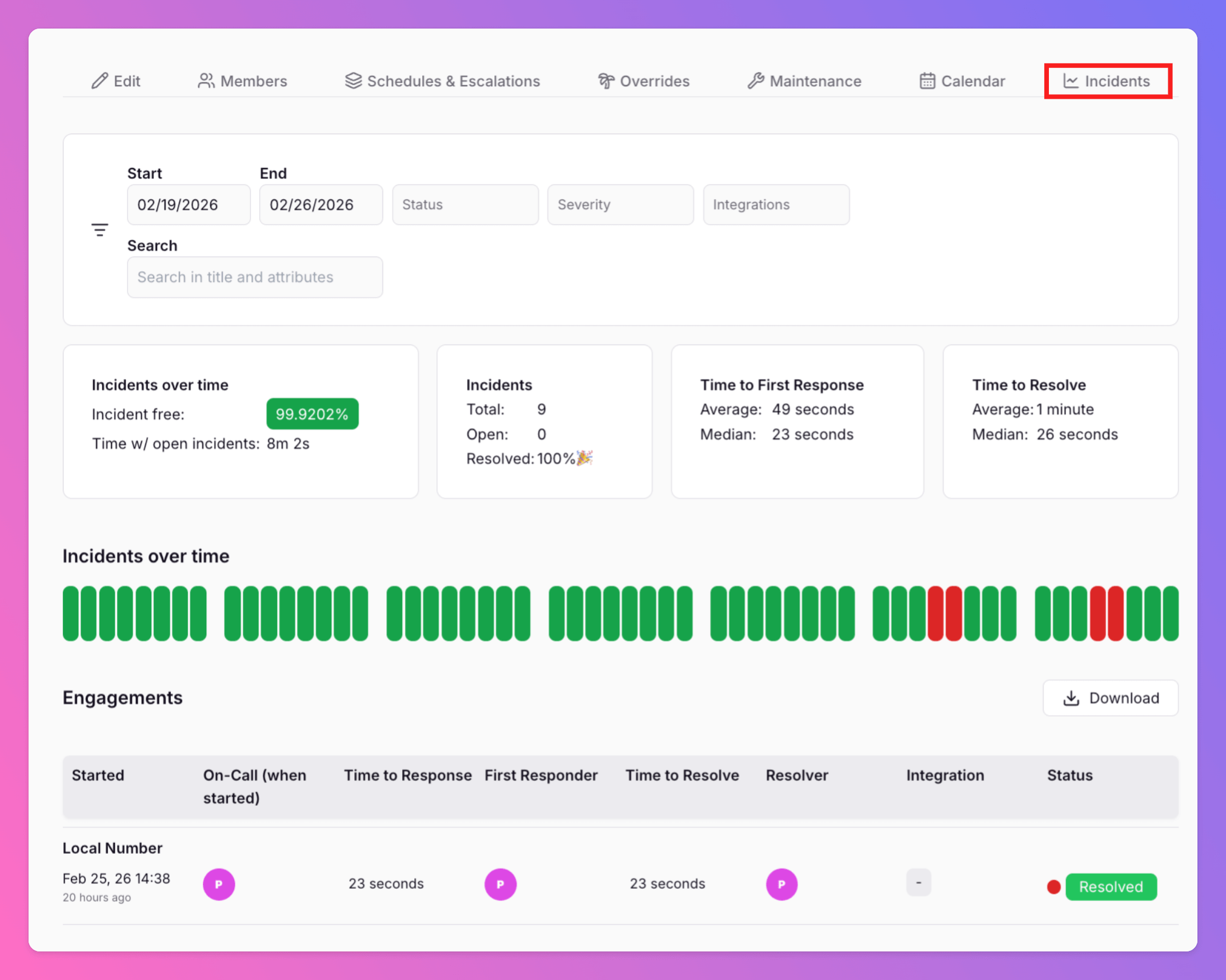
- Scheduled Delivery: Automatically sent every Monday at 7 AM local time for a consistent, timely overview of the past week’s activities. Reschedule the delivery in your team’s settings.
- Incident Management Summary: Snapshot of total incidents, percentage of resolved incidents and time with and without open incidents, highlighting effectiveness and responsiveness.
- Performance Metrics: Average and median response and resolution times, with details on individual incidents.
- Team Performance Analysis: Data analysis on team performance trends, with customizable sections for additional metrics.
Incident is Managed in 2+ Teams Or Team is Changed
Available for Pro and Enterprise users only via assign action.
- The incident will only be listed in the report as long as it remains in your team. If you assign an incident that was originally in this team to another team, it will only appear in the other team’s report.
- If an incident was assigned to your team after its creation, the values in the report may differ. See the example below.
- Example
- Incident is created in Team A (t=0 min)
- Team A, Member 1 acknowledges the incident (t=10 min)
- Incident is assigned to Team A & B (t=15 min)
- Team B, Member 2 acknowledges and resolves the incident (t=20 min)
- Team A Report:
- Started: 0 min
- Time To Response: 10 min
- First Responder: Team A, Member 1
- Time To Resolve: 20 min
- Resolver: Team B, Member 2
- On-Call (T1): Team A, Tier 1 Member(s) when incident was started
- Team B Report:
- Started: 15 min (the point in time when the incident was assigned to Team B)
- Time To Response: 5 min (20 min after creation, 5 min after assignment)
- First Responder: Team B, Member 2 (first responder after assignment)
- Time To Resolve: 5 min (20 min after creation, 5 min after assignment)
- Resolver: Team B, Member 2
- On-Call (T1): Team B, Tier 1 members, plus all notified Team A members, when incident was assigned to Team B in t=15 min
- Example