> ## Documentation Index
> Fetch the complete documentation index at: https://docs.allquiet.app/llms.txt
> Use this file to discover all available pages before exploring further.
# All Quiet Heartbeat Monitor
> Use our Heartbeat Monitor - your built-in dead man's switch notifies you instantly if a heartbeat is missed, so you can react before issues escalate.
Setup time: 2 Min
Set up our All Quiet Heartbeat Monitor to to ensure your scheduled jobs, background tasks, and critical services are always running. The monitor is set up within a few clicks. After setting it up, we'll create incidents so you never miss a failed heartbeat.
## 1. Create All Quiet Heartbeat Monitor
Sign in to your All Quiet account.
### Create Integration
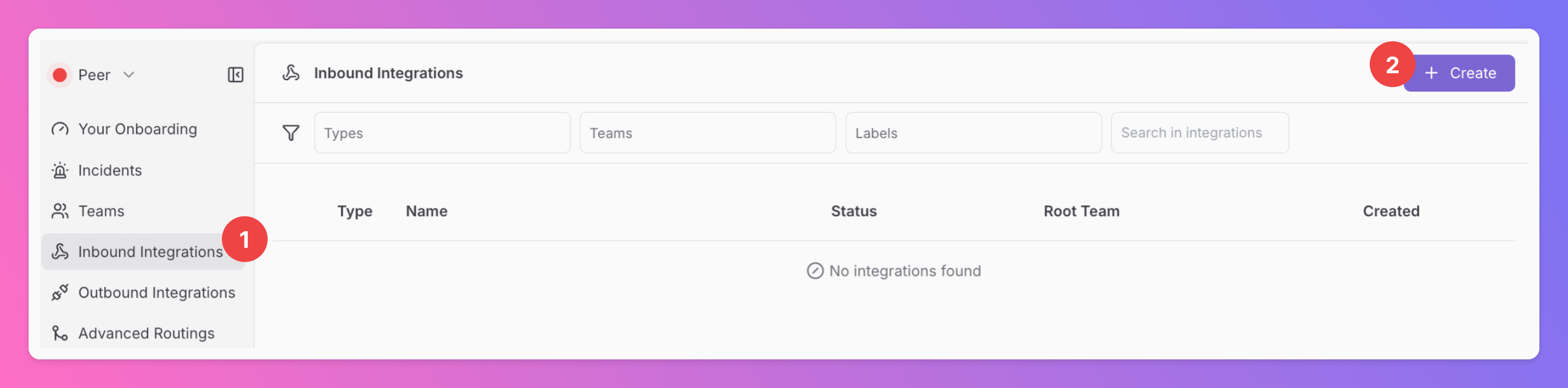
1. Click on the `Inbound Integrations` tab.
2. Click on `+ Create`.
 ### Select Heartbeat Monitor as the integration's type
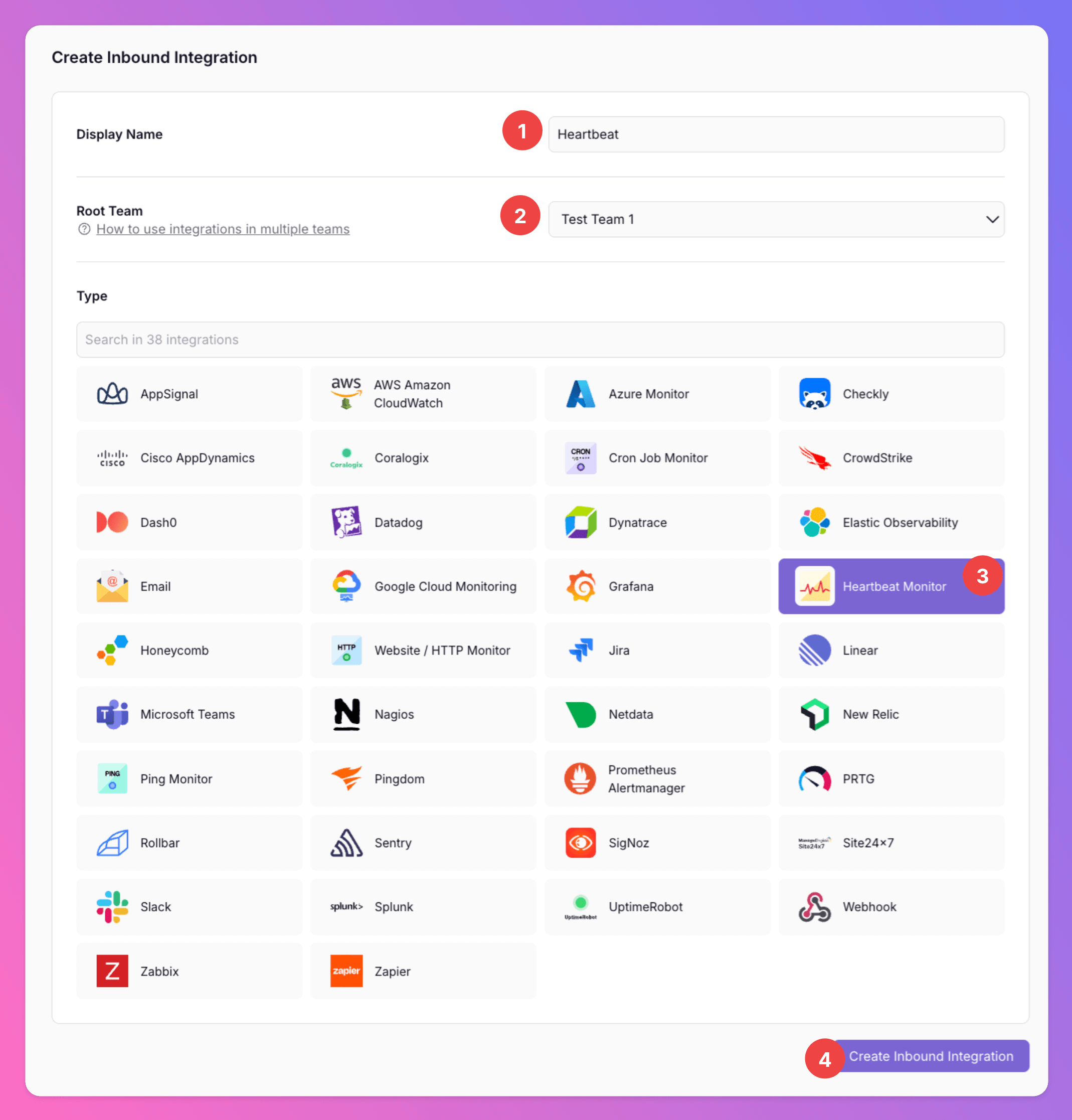
1. Enter a `Display Name` for your integration, e.g. "Heartbeat".
Pick a name that makes it obvious which service the heartbeat monitor belongs to.
2. Select a `Team`.
3. Select `Heartbeat Monitor` as the integration's type.
4. Click `Create Inbound Integration`.
### Select Heartbeat Monitor as the integration's type
1. Enter a `Display Name` for your integration, e.g. "Heartbeat".
Pick a name that makes it obvious which service the heartbeat monitor belongs to.
2. Select a `Team`.
3. Select `Heartbeat Monitor` as the integration's type.
4. Click `Create Inbound Integration`.
 ## 2. Configure your Heartbeat Monitor
Once you've set up the "Heartbeat Monitor", it's time to configure it. This can be done on the the integration's page.
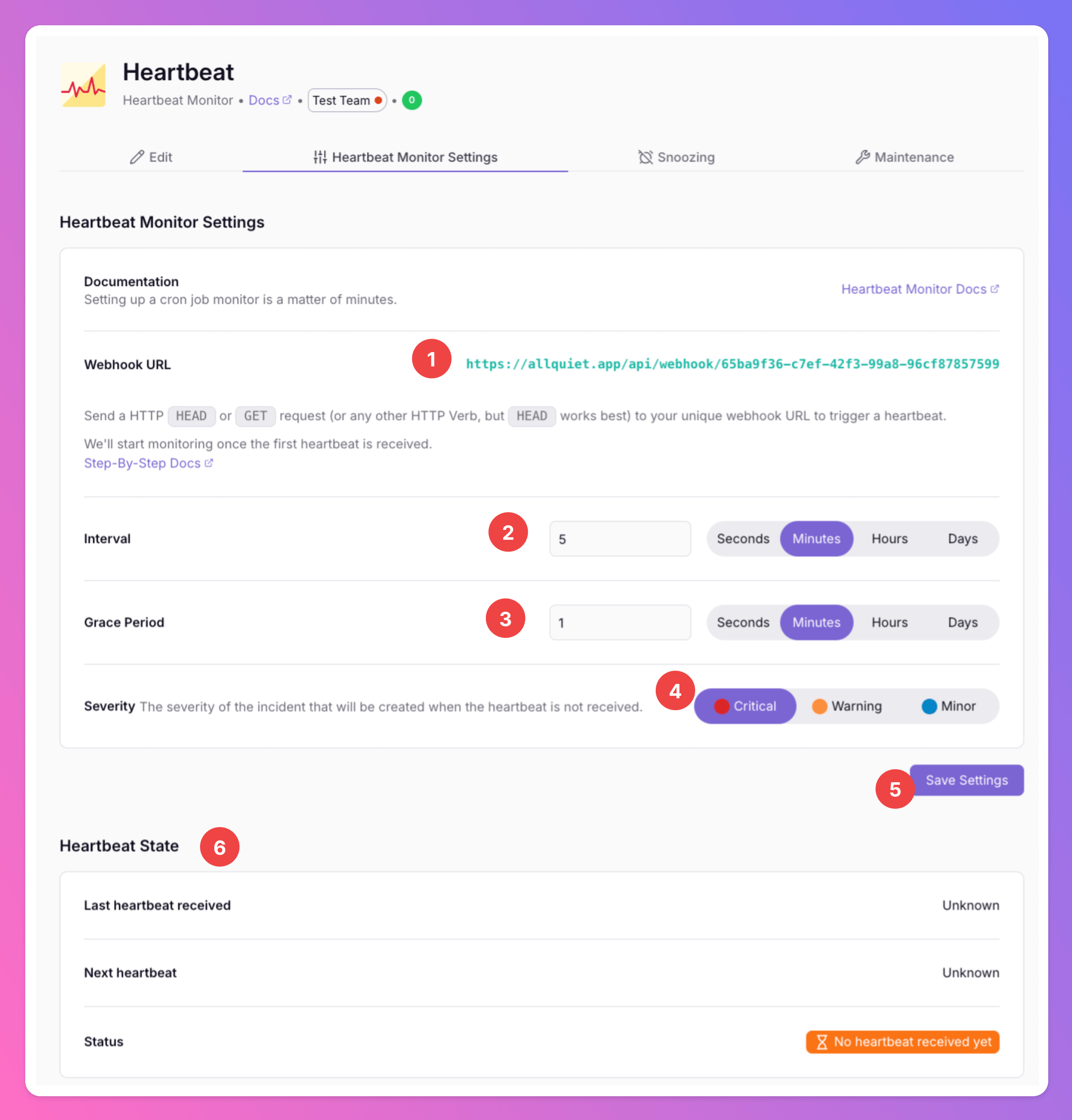
1. Here you find the unique Webhook URL that you need to ping.
2. Add an `Interval`. This is the interval you'd expect your heartbeat to ping the Webhook URL
3. You may add a `Gace Period`. If the heartbeat is delayed and not sent in the `Interval` but still sent to our Webhook URL within the `Grace Period` following the `Interval`, we will not create an incident.
4. Define a severity for incidents being created if the Heartbeat Monitor fails.
5. `Save` your settings.
6. As you can see the monitor is not activated yet.
## 2. Configure your Heartbeat Monitor
Once you've set up the "Heartbeat Monitor", it's time to configure it. This can be done on the the integration's page.
1. Here you find the unique Webhook URL that you need to ping.
2. Add an `Interval`. This is the interval you'd expect your heartbeat to ping the Webhook URL
3. You may add a `Gace Period`. If the heartbeat is delayed and not sent in the `Interval` but still sent to our Webhook URL within the `Grace Period` following the `Interval`, we will not create an incident.
4. Define a severity for incidents being created if the Heartbeat Monitor fails.
5. `Save` your settings.
6. As you can see the monitor is not activated yet.
 Optionally toggle `Enable additional Authentication & Security` below your Heartbeat Monitor settings to restrict who can POST payloads.
* **IP Filter** — Allow requests only from specific IPs or CIDR ranges. Failed checks return **404 Not Found**.
* **Bearer authentication** — Require `Authorization: Bearer YOUR_TOKEN`. Missing or invalid tokens return **401 Unauthorized**.
If both are enabled, the request must pass both checks to be accepted.
Your monitor is now set up and ready to be activated.
### Start Hearbeat Monitoring
To start monitoring, ping the Webhook URL you retrieved in the previous step.
On the bottom of the page, you will see
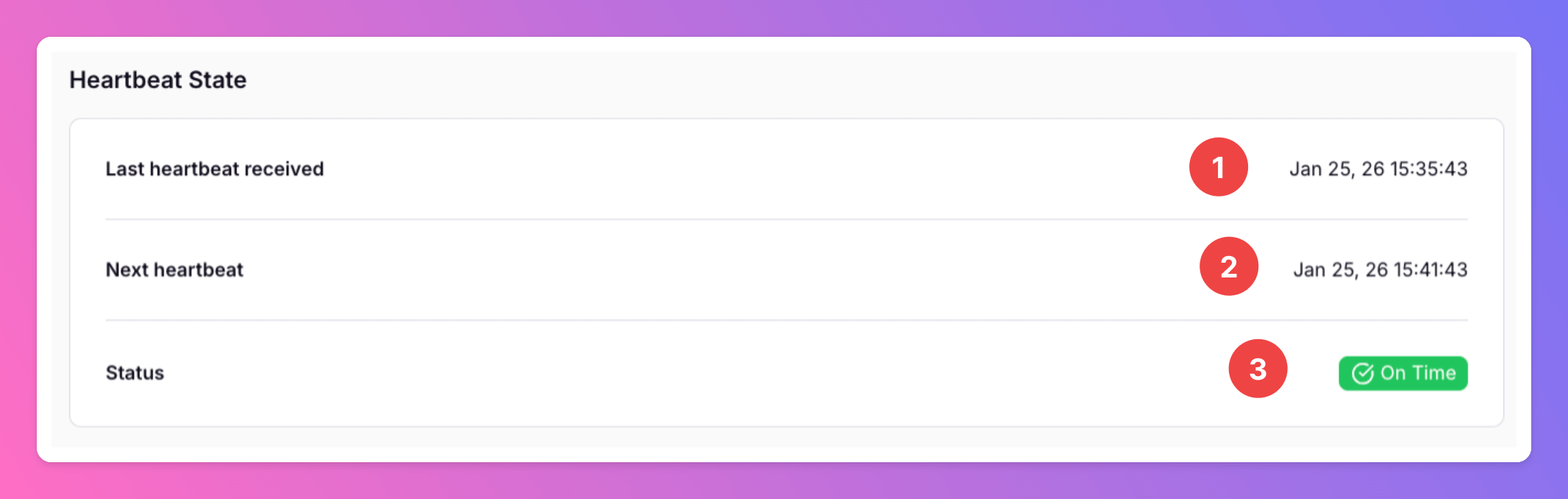
1. The last time a heartbeat was received.
2. The next time a heartbeat is expected based on your settings. If we don't receive a heartbeat until then, we'll create an All Quiet incident and notify you.
3. After the second heartbeat, we will start showing the current status of the Monitor
* `On Time` if the heartbeat was received within the expected timeframe (plus optional grace period)
* `Overdue` if we created an incident because we didn't receive the latest heartbeat on time.
Optionally toggle `Enable additional Authentication & Security` below your Heartbeat Monitor settings to restrict who can POST payloads.
* **IP Filter** — Allow requests only from specific IPs or CIDR ranges. Failed checks return **404 Not Found**.
* **Bearer authentication** — Require `Authorization: Bearer YOUR_TOKEN`. Missing or invalid tokens return **401 Unauthorized**.
If both are enabled, the request must pass both checks to be accepted.
Your monitor is now set up and ready to be activated.
### Start Hearbeat Monitoring
To start monitoring, ping the Webhook URL you retrieved in the previous step.
On the bottom of the page, you will see
1. The last time a heartbeat was received.
2. The next time a heartbeat is expected based on your settings. If we don't receive a heartbeat until then, we'll create an All Quiet incident and notify you.
3. After the second heartbeat, we will start showing the current status of the Monitor
* `On Time` if the heartbeat was received within the expected timeframe (plus optional grace period)
* `Overdue` if we created an incident because we didn't receive the latest heartbeat on time.
 Your monitor is active.
After changing your monitor's settings, you’ll need to reactivate it by sending a new ping to the Webhook URL.
Your monitor is active.
After changing your monitor's settings, you’ll need to reactivate it by sending a new ping to the Webhook URL.