> ## Documentation Index
> Fetch the complete documentation index at: https://docs.allquiet.app/llms.txt
> Use this file to discover all available pages before exploring further.
# Live Call Routing
> Configure how inbound calls are routed to on-call responders after your number is connected
In All Quiet, Live Call Routing is only available for the Pro and Enterprise plan. **Organization Administrators** and **Organization Owners** can create Call Routing Numbers. **Team Administrators** can edit existing numbers whose **Root Team** is a team they administer — but cannot create new ones.
Live Call Routing in All Quiet is **Bring Your Own Number (BYON)**: you keep (or provision) your phone number with Twilio, and All Quiet routes incoming calls to the right responders.
To set up Live Call Routing, start with ordering a phone number from Twilio and connecting it with your All Quiet account. You can find the instructions in our [step-by-step guide for Twilio](/integrations/inbound/twilio).
After that, you can set up Live Call Routing in All Quiet by following the steps in this documentation page.
## Overview
This guide picks up where the [Twilio integration setup](/integrations/inbound/twilio) leaves off. That guide walks you through buying a number, creating a Call Routing Number in All Quiet, and connecting your Twilio credentials. Once the connection shows a green checkmark, you are ready to configure **how** incoming calls are handled — caller allow & block lists, welcome messages, routing modes, dial chains, voicemail, and fallbacks.
Here you will learn:
* How a call flows from the welcome message through the on-call chain to a connected responder or voicemail. It also explains **when and how incidents are created for incoming calls**.
* What each setting on the **Call Routing** tab does, and how to tune them for your team.
* What snoozing, maintenance, and mute do — and what they **don’t** affect for live calls.
* How to block or allow callers in the **Call Routing** tab — and what to watch for if you also filter at your provider (Twilio).
Open your Call Routing Number in All Quiet and switch to the **Call Routing** tab when you configure settings. All options described under [Call routing tab](#call-routing-tab) live there.
### Prerequisites
Before configuring Live Call Routing, make sure:
1. **Twilio is connected** — you completed the steps in the [Twilio integration guide](/integrations/inbound/twilio) and the integration shows a valid connection.
2. **Your team has [on-call schedules](/essentials/escalations#schedules) and [escalation tiers](/essentials/escalations#escalation-tiers)** — call routing uses the same on-call chain as incident escalations, not a separate call-specific policy.
3. **On-call members have [confirmed phone numbers](/essentials/channels#sms-and-phone-calls) on their All Quiet profiles** — only members who are online and have a phone number configured can be dialed.
4. **You have permission to configure the number** — creating a Call Routing Number requires **Organization Administrator** or **Organization Owner** rights. **Team Administrators** can edit call routing, Twilio settings, and operational tabs for numbers whose **Root Team** they administer.
### Quick mental model
**Call routing is always live.** When someone dials your number, All Quiet routes the call according to your Call Routing settings. Integration snooze, maintenance windows, and mute mostly affect **incidents** and alert notifications — they do not stop the phone from ringing. See [What snoozing, maintenance, and mute do](#what-snoozing-maintenance-and-mute-do-and-don’t-do) for details.
## How a call flows
Before you tune individual settings, it helps to understand the end-to-end path of an inbound call. The diagram below shows every step; the numbered list underneath explains how All Quiet builds the on-call dial chain and how incidents are created.
```mermaid theme={null}
flowchart TD
A[Caller dials your number] --> BL{Allowed by allowlist / blocklist?}
BL -->|No| R[Reject — call blocked]
BL -->|Yes| B[Welcome message]
B --> C{Keypad menu?}
C -->|Yes| E[Caller presses key]
C -->|No| DV{Send directly to voicemail?}
E --> DV
DV -->|Yes| VM[Record voicemail → Open incident created]
DV -->|No| D[Resolve on-call chain for team]
D --> F[Dial person in on-call chain]
F -->|No answer / busy| H{More people in chain?}
H -->|Yes| F
H -->|No| I{Voicemail enabled?}
I -->|Yes| J[Record voicemail → Open incident created]
I -->|No| K[Play closing message → hang up, missed call, no incident created]
F -->|Answers + accepts| L[Bridge call to responder]
L -->|Call ends| M[Close call and create Open or Resolved incident]
```
1. **Caller allow & block lists** — When the call reaches All Quiet, the caller’s number is checked against your [allowlist and blocklist](#caller-allow-%26-block-lists). Blocked callers, or callers not on the allowlist when one is set, are rejected before routing begins.
2. **Welcome message** — The caller hears your configured welcome message (text-to-speech or uploaded audio). In keypad menu mode, this message must explain the menu options.
3. **Route selection** — In single-route mode, All Quiet uses the default route. In keypad menu mode, the caller picks a route by pressing 1–9; invalid keys and timeouts follow your menu settings.
4. **Direct voicemail shortcut** — Once a route is selected, All Quiet checks **Send caller directly to voicemail**. If enabled, the on-call dial chain is skipped: the caller records a voicemail and All Quiet creates a **new open incident** from that recording.
5. **On-call chain & dialing** — If direct voicemail is off, All Quiet resolves who to call from the route’s **Team to route to**, using that team’s on-call schedule and escalation tiers — the same chain used for incident escalations, not a separate call policy.
* Differences between Live Call Routing Escalations and Incident Escalations:
* Only online members with a confirmed phone number on their profile are candidates to receive a call.
* First, Tier 2 members are tried. One person is tried at a time, there is no parallel ring group. We randomly shuffle the order of the members in each tier for each call.
* [Round Robin](/essentials/escalations#round-robin-alerting) is ignored.
* If no one in Tier 1 answers the call, Tier 2 members are tried. We ignore if auto-escalations are enabled and we ignore the timeouts between tiers. We simply try the next person that is online in the team's on-call schedule.
* If [auto-assign](/essentials/escalations#auto-escalations-across-several-teams) is enabled in your team's escalations, it is ignored.
* [Repeat tiers](/essentials/escalations#repeat-escalation-tier) and [repeat escalations](/essentials/escalations#repeat-escalations) are ignored.
6. **Accept call** — The on-call member hears a prompt and must press 1 before the call is bridged to the caller. This prevents mailboxes and accidental pickups from connecting the caller.
7. **Escalation between people** — If someone doesn’t answer within **Dial timeout per user**, the next person is tried immediately — there is no wait between tiers. **Max users to call** caps how many people are tried before fallback.
8. **Fallback** — When the dial chain is exhausted, the caller hears your voicemail or a closing message. What happens next — incident or call log only — depends on your fallback settings. See [Incidents vs. call logs](#incidents-vs-call-logs) below.
### Incidents vs. call logs
Every inbound call appears in **Call Logs**, no matter how it ends. An **[incident](/essentials/incident)** is only created when the caller leaves a voicemail or when an on-call member **accepts** the call (presses 1 and is bridged to the caller). Other outcomes — such as a **Missed** call where no one accepts and voicemail is disabled — are logged as calls only.
| Outcome | Incident? | Status | Notes |
| -------------------------------------------------------------------------------------------------------------------------------------- | --------- | ------------ | -------------------------------------------------------------------------------------------------------------------------------------------------------------------------------------------------------------------------------------------------------------------------- |
| **Voicemail** (direct shortcut or after no one responds) | Yes | **Open** | Created when the caller finishes recording. Severity comes from the route’s **Incident severity** setting. If **Attach voicemail transcript to incident** is enabled, the transcript is added to the incident. On-Call members will receive normal incident notifications. |
| **Accepted call** (on-call member pressed 1 and call was bridged) with **Auto-resolve** incident when on-call answers **on** (default) | Yes | **Resolved** | All Quiet creates a Resolved incident after the call ends. No escalations are started for the on-call members. |
| **Accepted call** with **Auto-resolve** incident when on-call answers **off** | Yes | **Open** | The incident is created as open after the call ends and follows your team’s normal escalation workflow. |
| **Missed call** (closing message, voicemail disabled) | No | — | The caller hears the closing message and hangs up. The call is recorded in **Call Logs** only — for example as a missed call with no voicemail. |
| **Blocklisted** (caller rejected by allow/block list) | No | — | The call is hung up immediately — no welcome message, no on-call dial, no incident. Log step: `CallerBlocklisted`. See [Session outcomes](#session-outcomes). |
| **Any outcome during a [maintenance window](/essentials/inbound#maintenance-for-inbound-integrations)** | No | — | The call is still routed normally, but **incident creation is suppressed**. You will find the call in **Call Logs**, but no new incident is created. |
Use **Call Logs** to review every inbound attempt — who was dialed, menu choices, voicemail vs. missed, and call duration. Use the **Incidents** tab when you need actionable records that enter your on-call workflow (voicemails and taken calls).
### Concurrent inbound calls
When several callers ring at the same time, each call runs through the flow above independently — but they draw from the same on-call members for a team.
If an on-call member is already connected to another **live call** for that team, their phone number is **excluded from the dial chain** for any other inbound call. All Quiet will not ring the same number twice at once.
When every reachable member is already busy, a second caller’s dial chain can be exhausted quickly — the same outcome as when no one answers. If **Send to voicemail if no one responds** is enabled, that caller is sent to voicemail. This is expected behavior, not a misconfiguration. For high-volume hotlines, keep voicemail fallback enabled so concurrent callers can still leave a message.
The sections below walk through each setting on the **Call Routing** tab and how it maps to this flow.
## Call routing tab
Now that you know how a call moves through All Quiet, open the **Call Routing** tab on your Call Routing Number to configure each step.
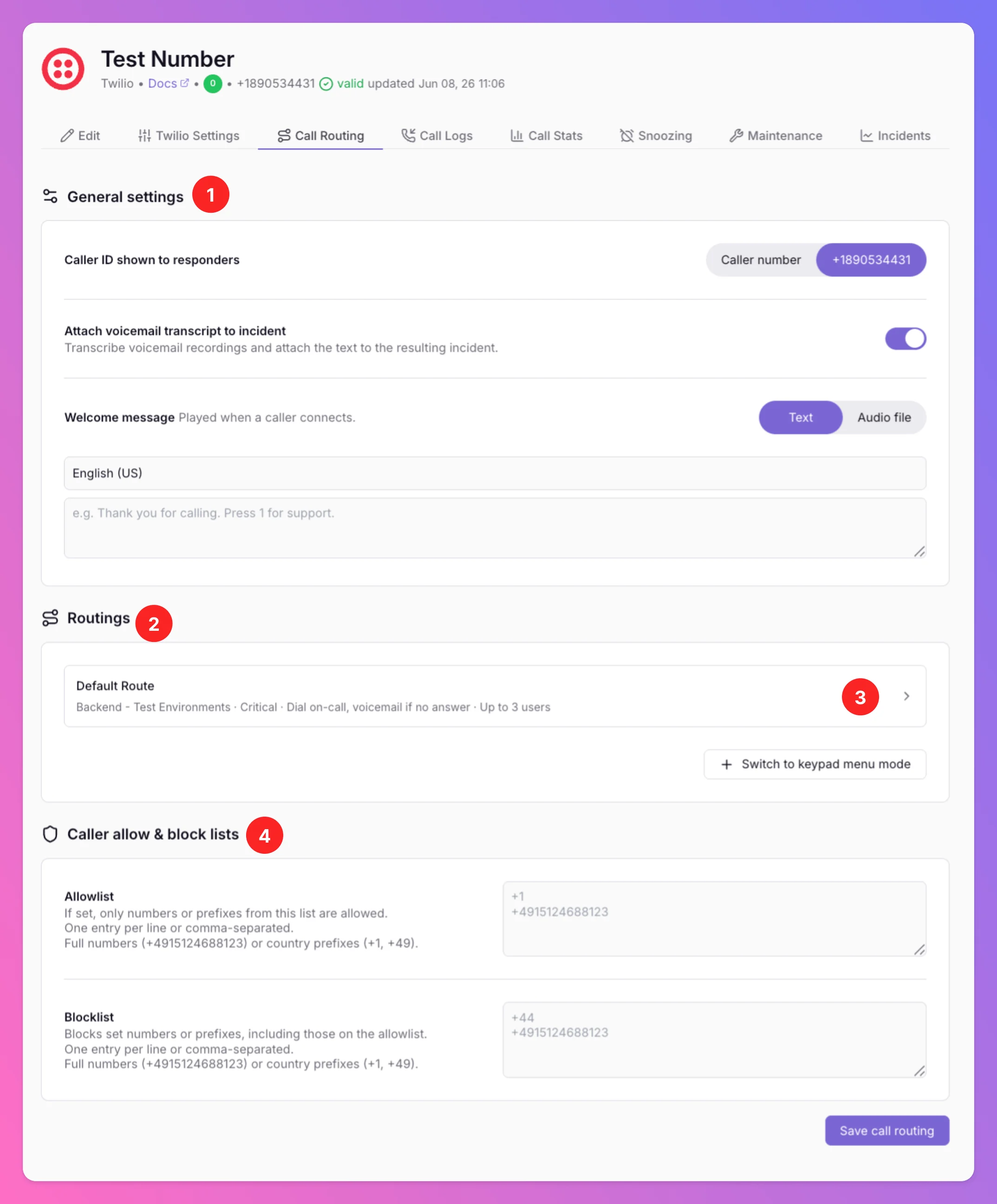
The tab is divided into four sections:
1. **[General settings](/advanced/live-call-routing#general-settings)**: Configure the general settings for the call routing number.
2. **[Routing modes](/advanced/live-call-routing#routing-modes)**: Configure the routing modes for the call routing number. Choose between [single route](/advanced/live-call-routing#single-route-default) and [keypad menu mode](/advanced/live-call-routing#keypad-menu-mode).
3. **[Per-route settings](/advanced/live-call-routing#per-route-settings-route-editor-modal)**: Configure the per-route settings for the call routing number. Choose the team to route to, the incident severity, and the caller fallback.
4. **[Caller allow & block lists](/advanced/live-call-routing#caller-allow-%26-block-lists)**: Allow or block callers by phone number or country prefix before routing begins.
 ### General settings
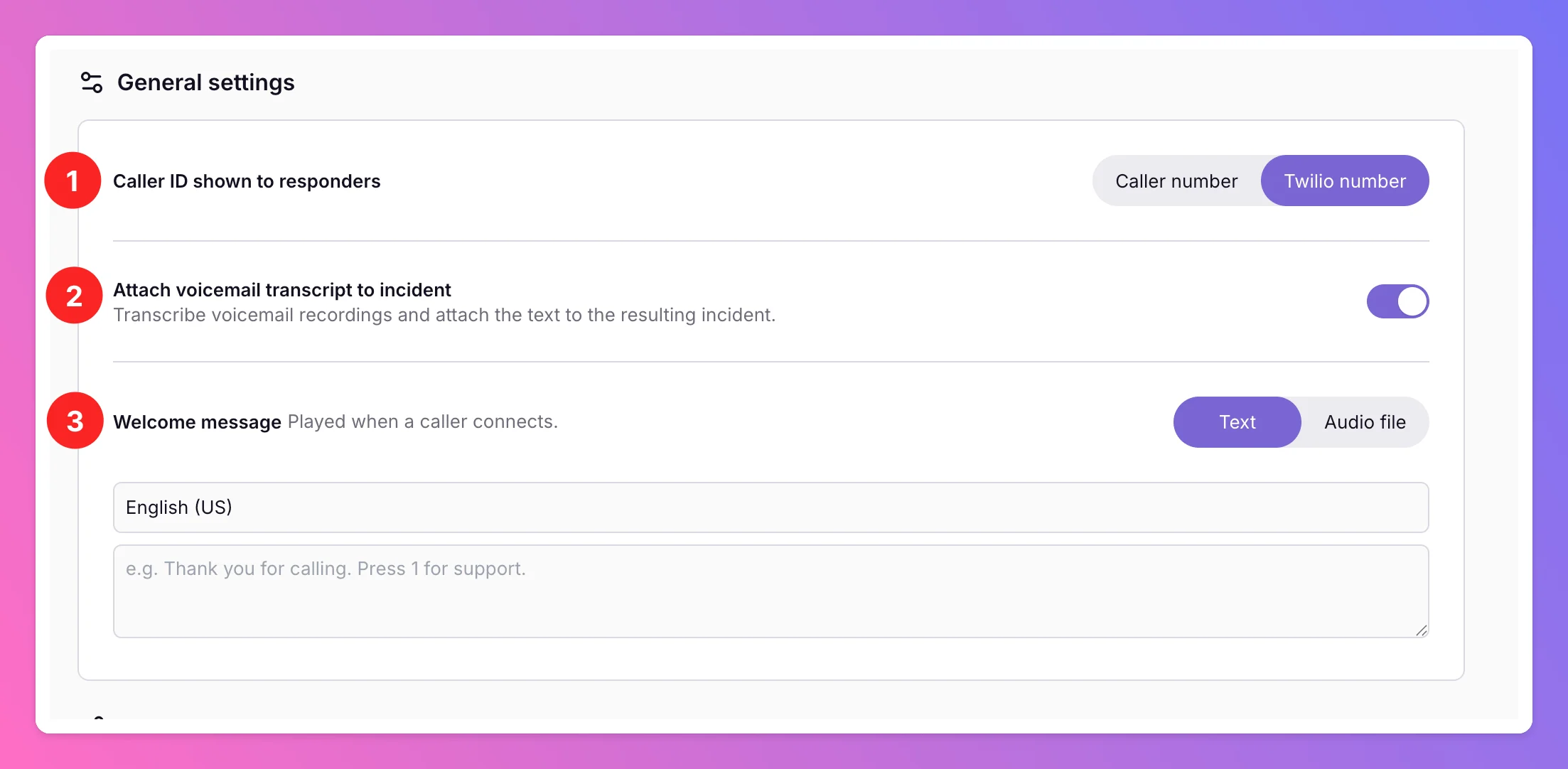
The general settings for your call routing number are:
1. **Caller ID shown to responders**: Show caller number vs. your inbound Twilio number. Helps responders recognize repeat callers vs. hotline number. We recommend showing the twilio number as the receiver can save it to their contacts for future reference and do not disturb overrides.
2. **Attach voicemail transcript to incident**: When enabled, voicemails are transcribed and attached to the resulting incidents.
Currently, Call transcripts are generated in **English only** — if callers use another language, consider disabling this option. The incident is created as soon as the voicemail is recorded; the transcript is added afterward and can take a few moments to appear on the incident via an update.
3. **Welcome message**: The message that is played to the caller before they are routed to the on-call chain. This can be a text-to-speech in your preferred language or uploaded audio file. In [keypad menu mode](/advanced/live-call-routing#keypad-menu-mode), you should explain keypad options here.
### General settings
The general settings for your call routing number are:
1. **Caller ID shown to responders**: Show caller number vs. your inbound Twilio number. Helps responders recognize repeat callers vs. hotline number. We recommend showing the twilio number as the receiver can save it to their contacts for future reference and do not disturb overrides.
2. **Attach voicemail transcript to incident**: When enabled, voicemails are transcribed and attached to the resulting incidents.
Currently, Call transcripts are generated in **English only** — if callers use another language, consider disabling this option. The incident is created as soon as the voicemail is recorded; the transcript is added afterward and can take a few moments to appear on the incident via an update.
3. **Welcome message**: The message that is played to the caller before they are routed to the on-call chain. This can be a text-to-speech in your preferred language or uploaded audio file. In [keypad menu mode](/advanced/live-call-routing#keypad-menu-mode), you should explain keypad options here.
 ### Routing modes
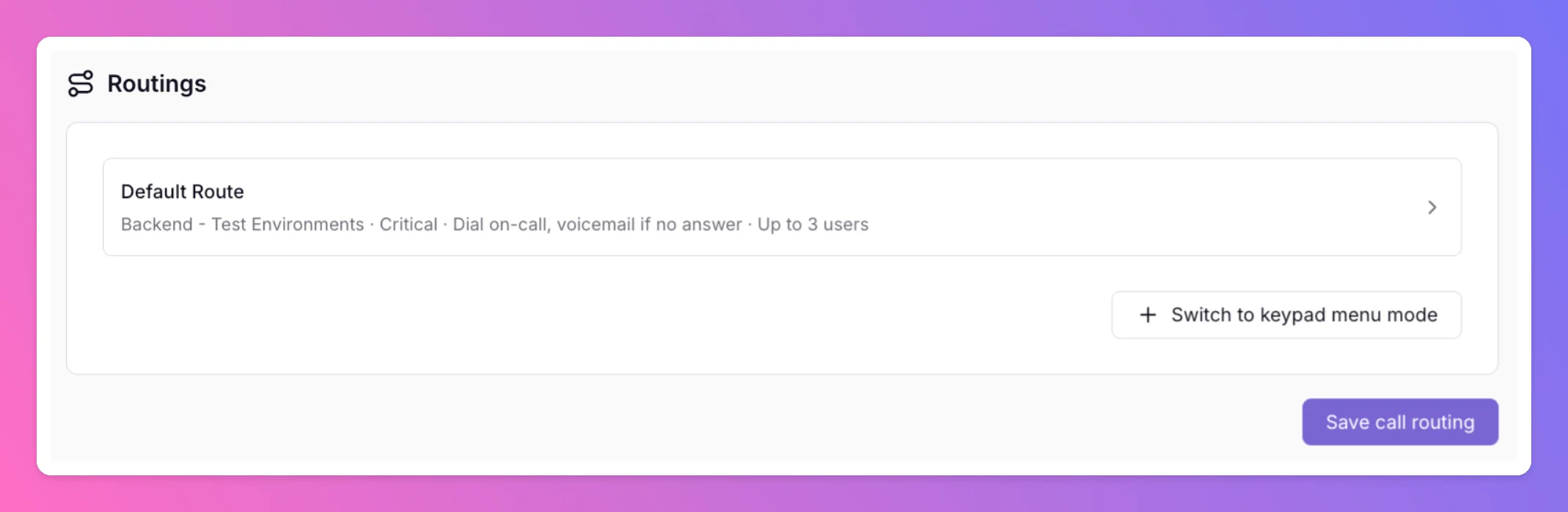
Per default, incoming calls are sent to a single route in you integration's root team. You can configure this in the **Routing modes** section.
#### Single route (default)
One team, one route. Good for a single hotline. Click on the route to edit it. The [route editor modal](/advanced/live-call-routing#per-route-settings-route-editor-modal) will open.
### Routing modes
Per default, incoming calls are sent to a single route in you integration's root team. You can configure this in the **Routing modes** section.
#### Single route (default)
One team, one route. Good for a single hotline. Click on the route to edit it. The [route editor modal](/advanced/live-call-routing#per-route-settings-route-editor-modal) will open.
 #### Keypad menu mode
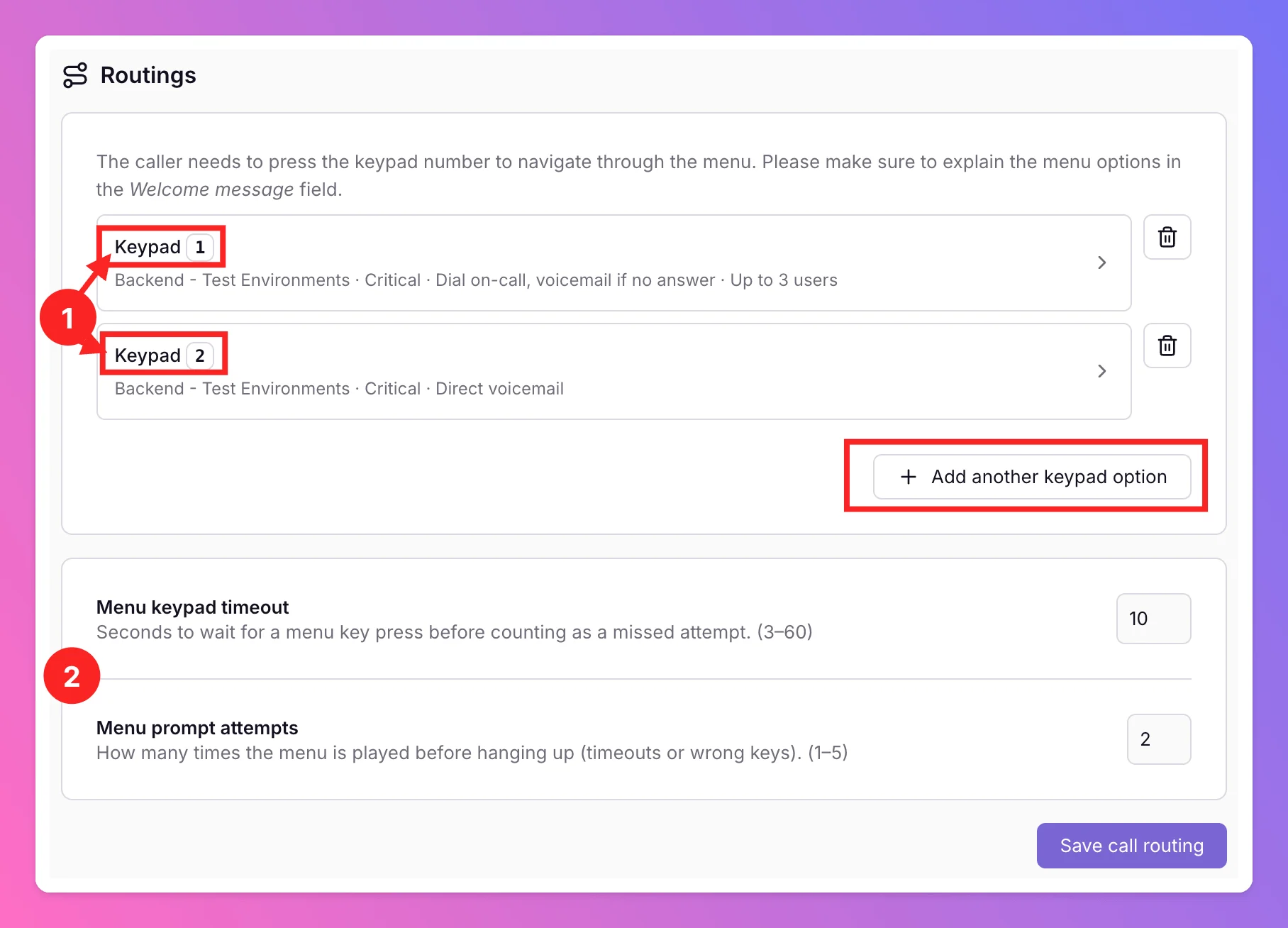
The keypad menu mode allows the caller to pick a route by pressing a number between 1 and 9. it is activated by clicking on `+ Add another keypad option` while in single route mode.
1. You can see your routes and there current settings. Caller presses 1–9 to pick a route (e.g. “Press 1 for production, 2 for billing”).
2. Define timeouts and tries for the caller in the keypad menu
* **Menu keypad timeout**: Seconds to wait for input before re-prompting.
* **Menu prompt attempts**: How many times the menu is played before hanging up (including timeouts or wrong keys).
#### Keypad menu mode
The keypad menu mode allows the caller to pick a route by pressing a number between 1 and 9. it is activated by clicking on `+ Add another keypad option` while in single route mode.
1. You can see your routes and there current settings. Caller presses 1–9 to pick a route (e.g. “Press 1 for production, 2 for billing”).
2. Define timeouts and tries for the caller in the keypad menu
* **Menu keypad timeout**: Seconds to wait for input before re-prompting.
* **Menu prompt attempts**: How many times the menu is played before hanging up (including timeouts or wrong keys).
 ### Per-route settings (route editor modal)
When clicking on a route, the route editor modal will open.
It is divided into four sections:
1. **[Routing](/advanced/live-call-routing#routing)**: Configure the team and severity for the route.
2. **[Caller fallback](/advanced/live-call-routing#caller-fallback)**: Configure what should happen if no one answers the call for the route. Or, send the caller directly to voicemail.
3. **[On-call dialing](/advanced/live-call-routing#on-call-dialing)**: Configure the on-call dialing for the route. How many users are tried, how long to wait for each user to answer, and what happens if someone answers the call.
4. **[Accept call](/advanced/live-call-routing#accept-call)**: Configure how on-call members are required to accept the call for the route. To prevent mailboxes from answering calls, **on-call members are always required to press 1 before the call is bridged to the caller**.
### Per-route settings (route editor modal)
When clicking on a route, the route editor modal will open.
It is divided into four sections:
1. **[Routing](/advanced/live-call-routing#routing)**: Configure the team and severity for the route.
2. **[Caller fallback](/advanced/live-call-routing#caller-fallback)**: Configure what should happen if no one answers the call for the route. Or, send the caller directly to voicemail.
3. **[On-call dialing](/advanced/live-call-routing#on-call-dialing)**: Configure the on-call dialing for the route. How many users are tried, how long to wait for each user to answer, and what happens if someone answers the call.
4. **[Accept call](/advanced/live-call-routing#accept-call)**: Configure how on-call members are required to accept the call for the route. To prevent mailboxes from answering calls, **on-call members are always required to press 1 before the call is bridged to the caller**.
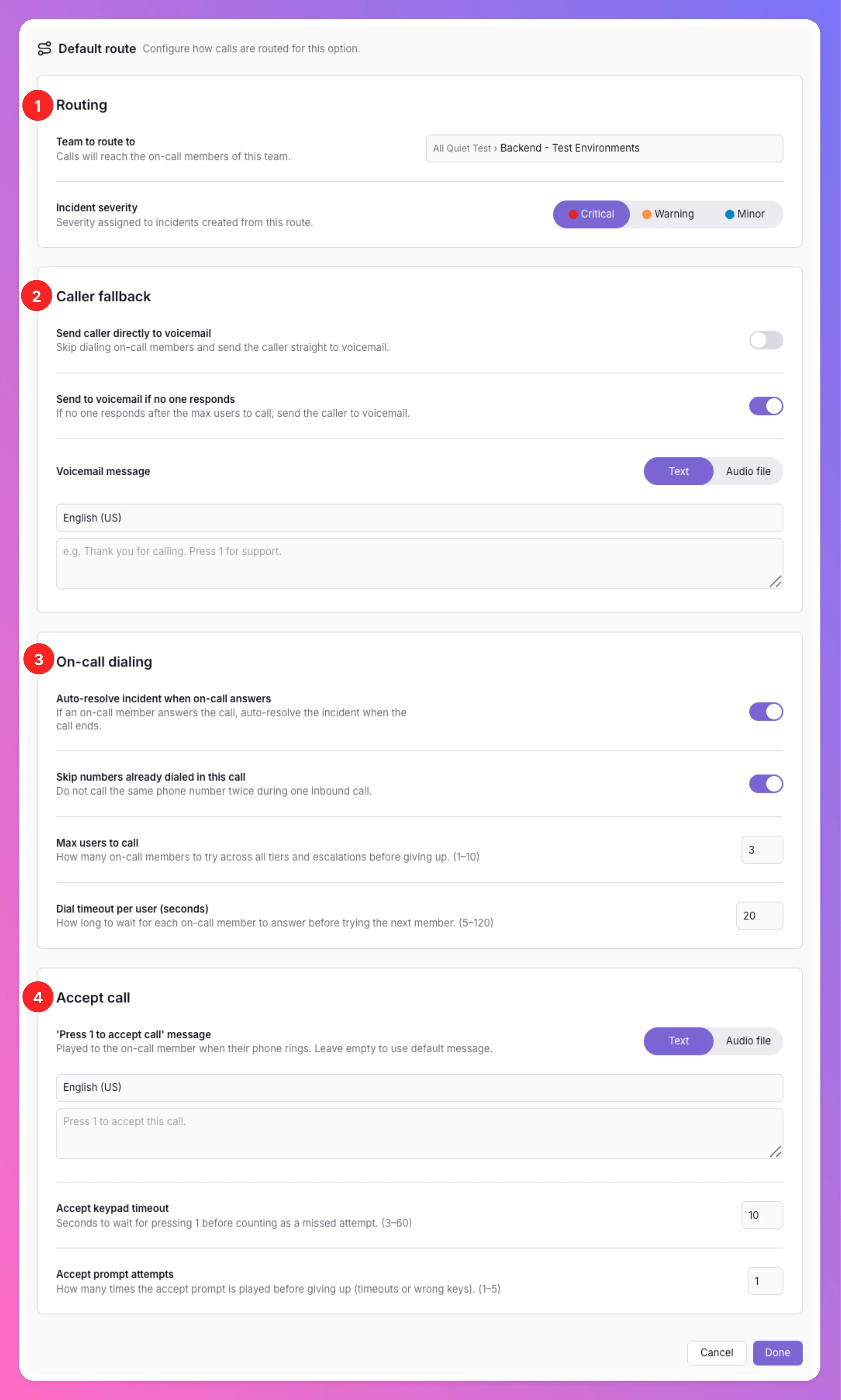 #### Routing
These settings define which team handles the call and how the resulting incident is classified.
1. **Team to route to** — Select the team whose on-call members should be dialed when this route is used. You can choose between your integration's root team and other teams within the root team's organization — which teams appear in the list depends on your role. **Team Administrators** can select teams they administer; **Organization Administrators** and **Organization Owners** can select from all teams in the organization. All Quiet builds the dial chain from that team’s [on-call schedule and escalation tiers](/essentials/escalations) — the same chain used for incident escalations. In keypad menu mode, each menu option can route to a different team.
2. **Incident severity** — Set the severity for incidents created from this route (answered calls and voicemails). Use this to distinguish a production hotline from a lower-priority line, or to align call-based incidents with your existing severity workflow.
#### Caller fallback
These settings control what happens when no one answers, or when you want callers to reach voicemail without dialing anyone.
**Send caller directly to voicemail** — When enabled, All Quiet skips the [on-call dial chain](/advanced/live-call-routing#on-call-dialing) entirely and sends the caller straight to voicemail. Useful for after-hours lines, overflow numbers, or routes where you only want to collect messages. You can add a custom voicemail message here that is played after the [welcome message](/advanced/live-call-routing#general-settings). Choose between text-to-speech in your preferred language or uploaded audio.
Max length for the voicemail message is 2 minutes.
#### Routing
These settings define which team handles the call and how the resulting incident is classified.
1. **Team to route to** — Select the team whose on-call members should be dialed when this route is used. You can choose between your integration's root team and other teams within the root team's organization — which teams appear in the list depends on your role. **Team Administrators** can select teams they administer; **Organization Administrators** and **Organization Owners** can select from all teams in the organization. All Quiet builds the dial chain from that team’s [on-call schedule and escalation tiers](/essentials/escalations) — the same chain used for incident escalations. In keypad menu mode, each menu option can route to a different team.
2. **Incident severity** — Set the severity for incidents created from this route (answered calls and voicemails). Use this to distinguish a production hotline from a lower-priority line, or to align call-based incidents with your existing severity workflow.
#### Caller fallback
These settings control what happens when no one answers, or when you want callers to reach voicemail without dialing anyone.
**Send caller directly to voicemail** — When enabled, All Quiet skips the [on-call dial chain](/advanced/live-call-routing#on-call-dialing) entirely and sends the caller straight to voicemail. Useful for after-hours lines, overflow numbers, or routes where you only want to collect messages. You can add a custom voicemail message here that is played after the [welcome message](/advanced/live-call-routing#general-settings). Choose between text-to-speech in your preferred language or uploaded audio.
Max length for the voicemail message is 2 minutes.
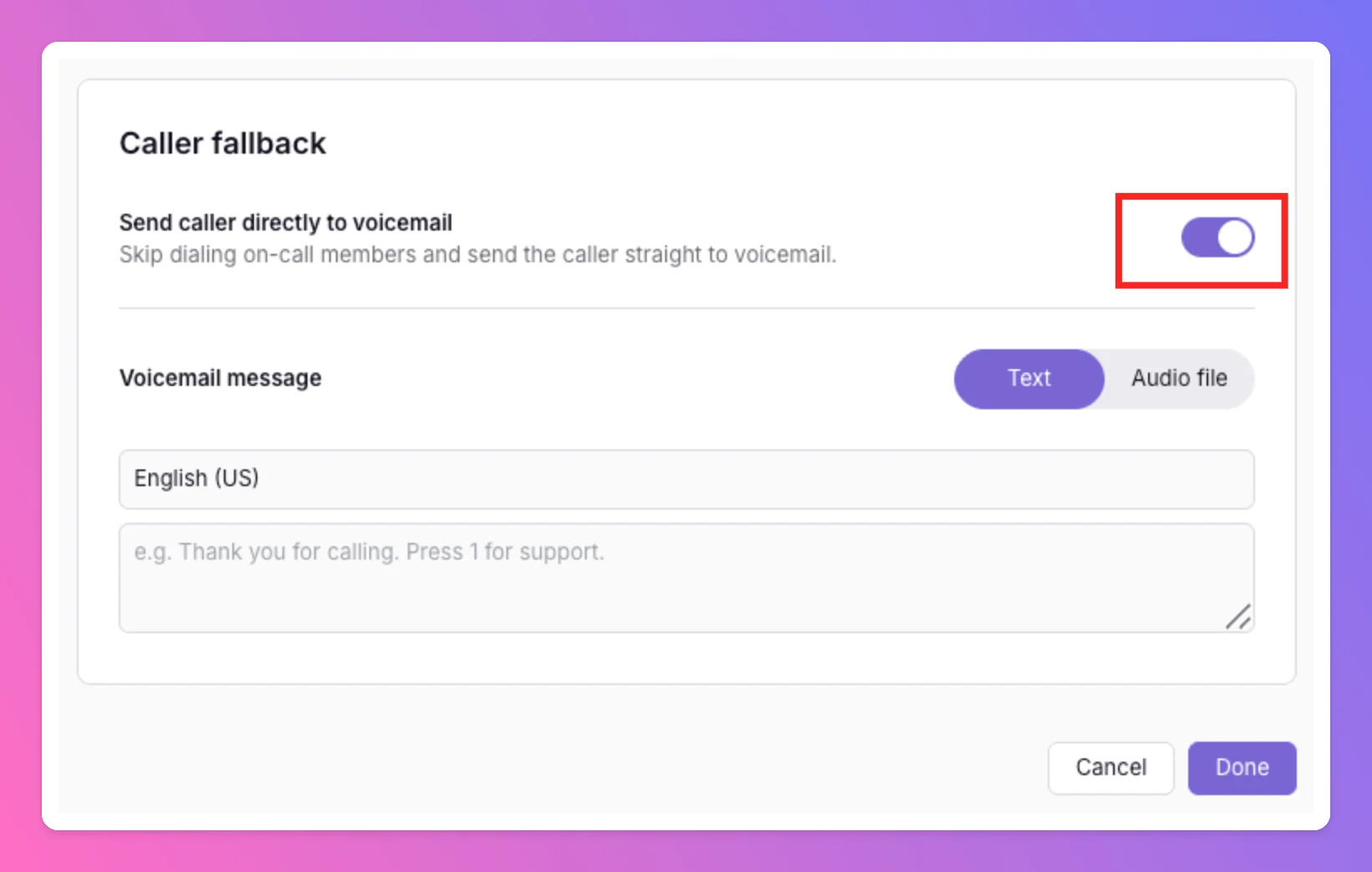 If **Send caller directly to voicemail** is disabled, you can configure what happens when no one answers the call after trying the [on-call dial chain](/advanced/live-call-routing#on-call-dialing).
**Send to voicemail if no one responds** — When enabled, callers who reach the end of the dial chain (everyone tried within **Max users to call** did not answer and accept the call) are sent to voicemail instead of hearing a closing message and hanging up. This is the most common fallback for operational hotlines. If disabled, the caller will hear a closing message and hang up.
Max length for the voicemail message is 2 minutes.
If **Send caller directly to voicemail** is disabled, you can configure what happens when no one answers the call after trying the [on-call dial chain](/advanced/live-call-routing#on-call-dialing).
**Send to voicemail if no one responds** — When enabled, callers who reach the end of the dial chain (everyone tried within **Max users to call** did not answer and accept the call) are sent to voicemail instead of hearing a closing message and hanging up. This is the most common fallback for operational hotlines. If disabled, the caller will hear a closing message and hang up.
Max length for the voicemail message is 2 minutes.
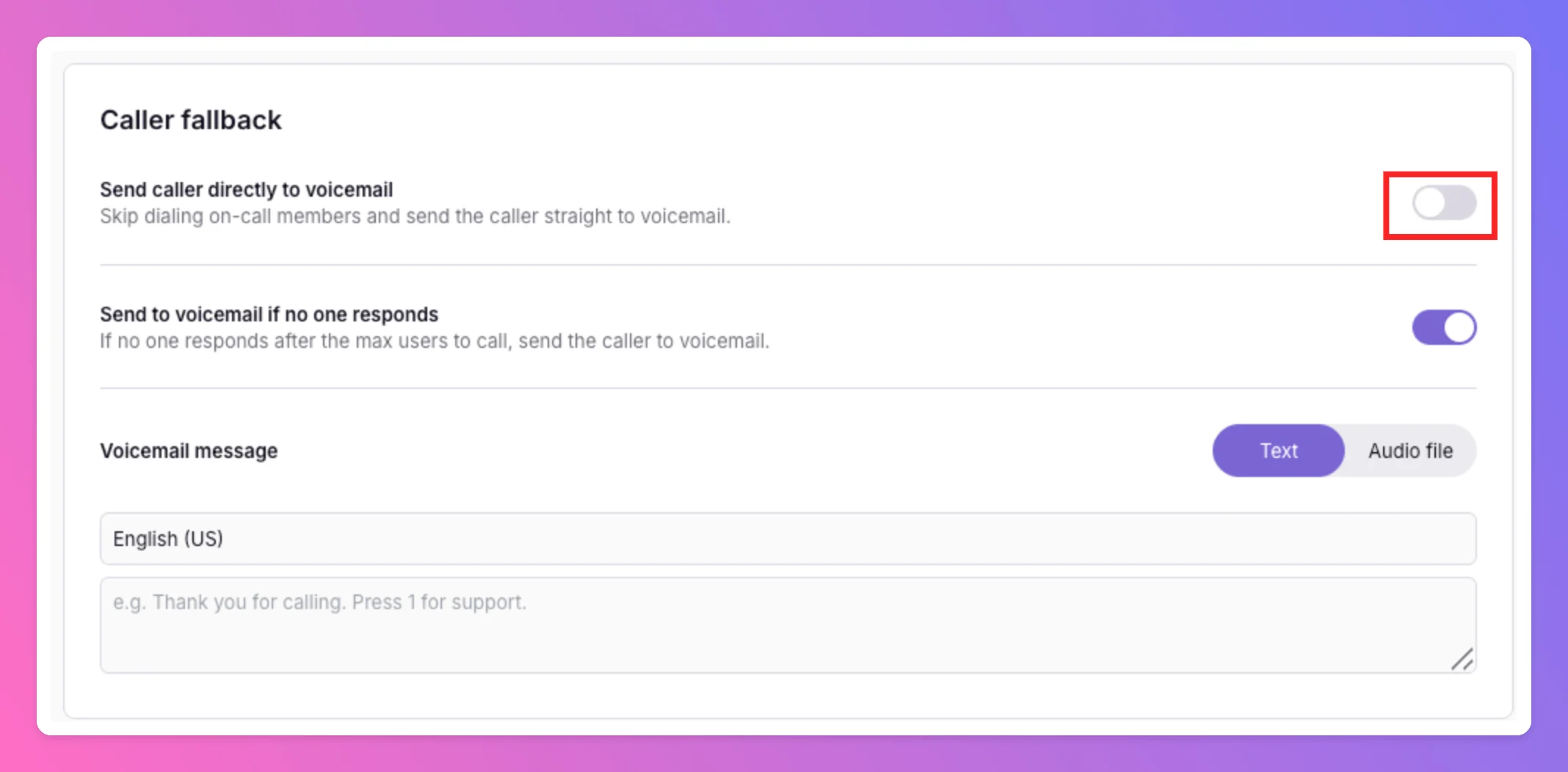 **Voicemail message** — The message played before the caller can leave a voicemail. Applies when direct voicemail or “no one responds” voicemail is active. Can be text-to-speech or uploaded audio.
**Closing message** — The message played when the dial chain is exhausted and voicemail is **not** enabled. After this message, the call ends. The call is logged in **Call Logs** as a missed call; **no incident is created**. See [Incidents vs. call logs](#incidents-vs-call-logs).
#### On-call dialing
These settings fine-tune how All Quiet walks through the on-call chain and what happens when someone picks up.
**Auto-resolve incident when on-call answers** — Enabled by default. When an on-call member accepts and the call is bridged, All Quiet creates an incident that is **automatically resolved** when the call ends. Turn this off if you want answered calls to leave an **open** incident that enters your team’s normal escalation workflow. See [Incidents vs. call logs](#incidents-vs-call-logs) for a full breakdown.
**Skip numbers already dialed in this call** — When enabled, All Quiet will not ring the same phone number twice during a single inbound call session. Helps avoid calling the same person again if they appear in multiple escalation tiers.
**Max users to call** (1–10, default **3**) — Caps how many on-call members are tried across all escalation tiers before fallback (voicemail or closing message). Increase this for larger teams or longer chains; keep it lower if you want callers to reach voicemail quickly when the first few people are unavailable.
**Dial timeout per user** (5–120 seconds, default **20**) — How long All Quiet waits for each person to answer before moving to the next person in the chain. There is no additional delay between tiers — the next person is dialed immediately after the timeout. Shorter timeouts reach voicemail faster; longer timeouts give responders more time to pick up (e.g. when they need to find a quiet place).
**Voicemail message** — The message played before the caller can leave a voicemail. Applies when direct voicemail or “no one responds” voicemail is active. Can be text-to-speech or uploaded audio.
**Closing message** — The message played when the dial chain is exhausted and voicemail is **not** enabled. After this message, the call ends. The call is logged in **Call Logs** as a missed call; **no incident is created**. See [Incidents vs. call logs](#incidents-vs-call-logs).
#### On-call dialing
These settings fine-tune how All Quiet walks through the on-call chain and what happens when someone picks up.
**Auto-resolve incident when on-call answers** — Enabled by default. When an on-call member accepts and the call is bridged, All Quiet creates an incident that is **automatically resolved** when the call ends. Turn this off if you want answered calls to leave an **open** incident that enters your team’s normal escalation workflow. See [Incidents vs. call logs](#incidents-vs-call-logs) for a full breakdown.
**Skip numbers already dialed in this call** — When enabled, All Quiet will not ring the same phone number twice during a single inbound call session. Helps avoid calling the same person again if they appear in multiple escalation tiers.
**Max users to call** (1–10, default **3**) — Caps how many on-call members are tried across all escalation tiers before fallback (voicemail or closing message). Increase this for larger teams or longer chains; keep it lower if you want callers to reach voicemail quickly when the first few people are unavailable.
**Dial timeout per user** (5–120 seconds, default **20**) — How long All Quiet waits for each person to answer before moving to the next person in the chain. There is no additional delay between tiers — the next person is dialed immediately after the timeout. Shorter timeouts reach voicemail faster; longer timeouts give responders more time to pick up (e.g. when they need to find a quiet place).
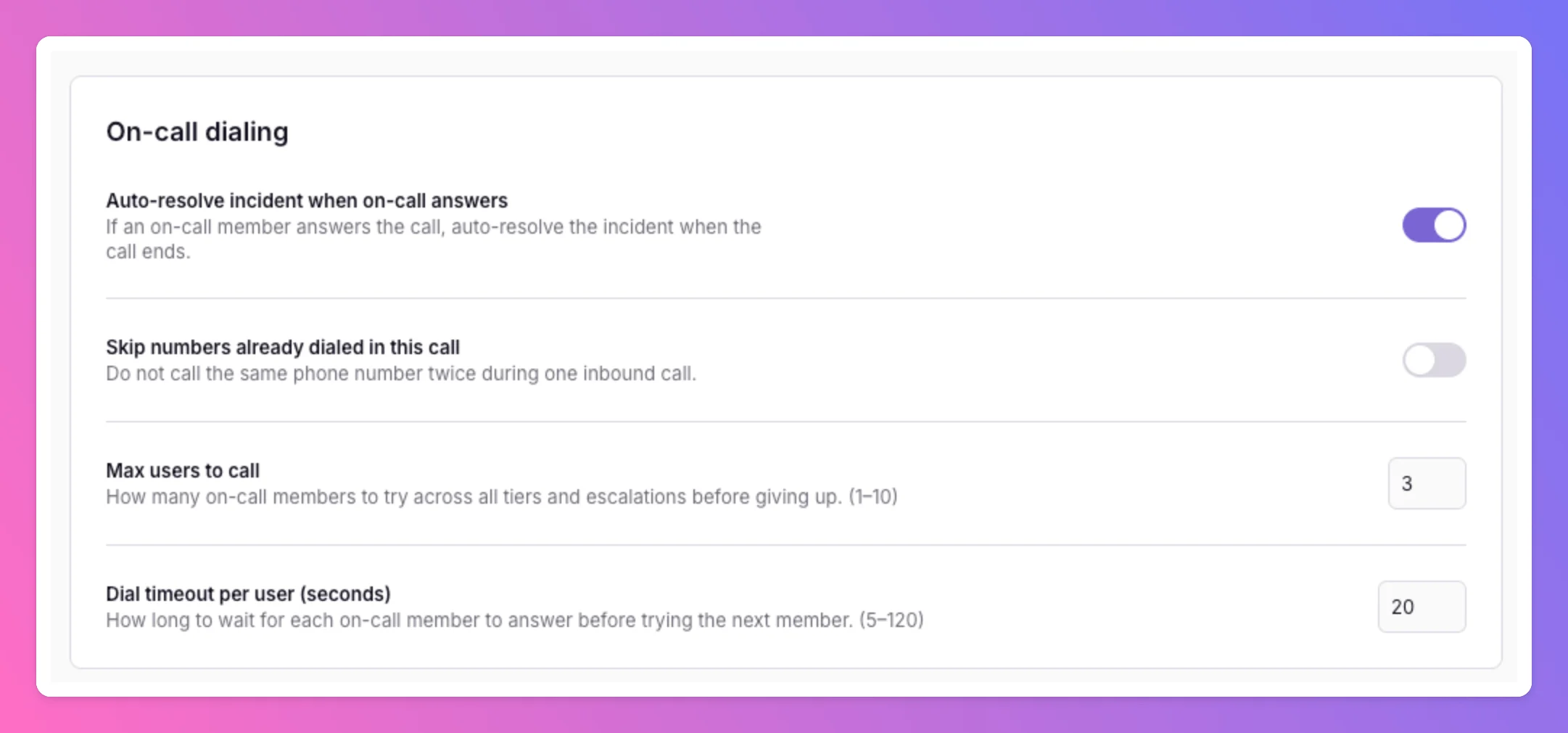 Start with the defaults (max **3** users, **20** seconds per user) and adjust based on your team size and how quickly callers should reach voicemail. See [How a call flows](#how-a-call-flows) for how these settings fit into the overall call path.
#### Accept call
Before bridging the caller to an on-call member, All Quiet requires the responder to confirm they are ready to take the call.
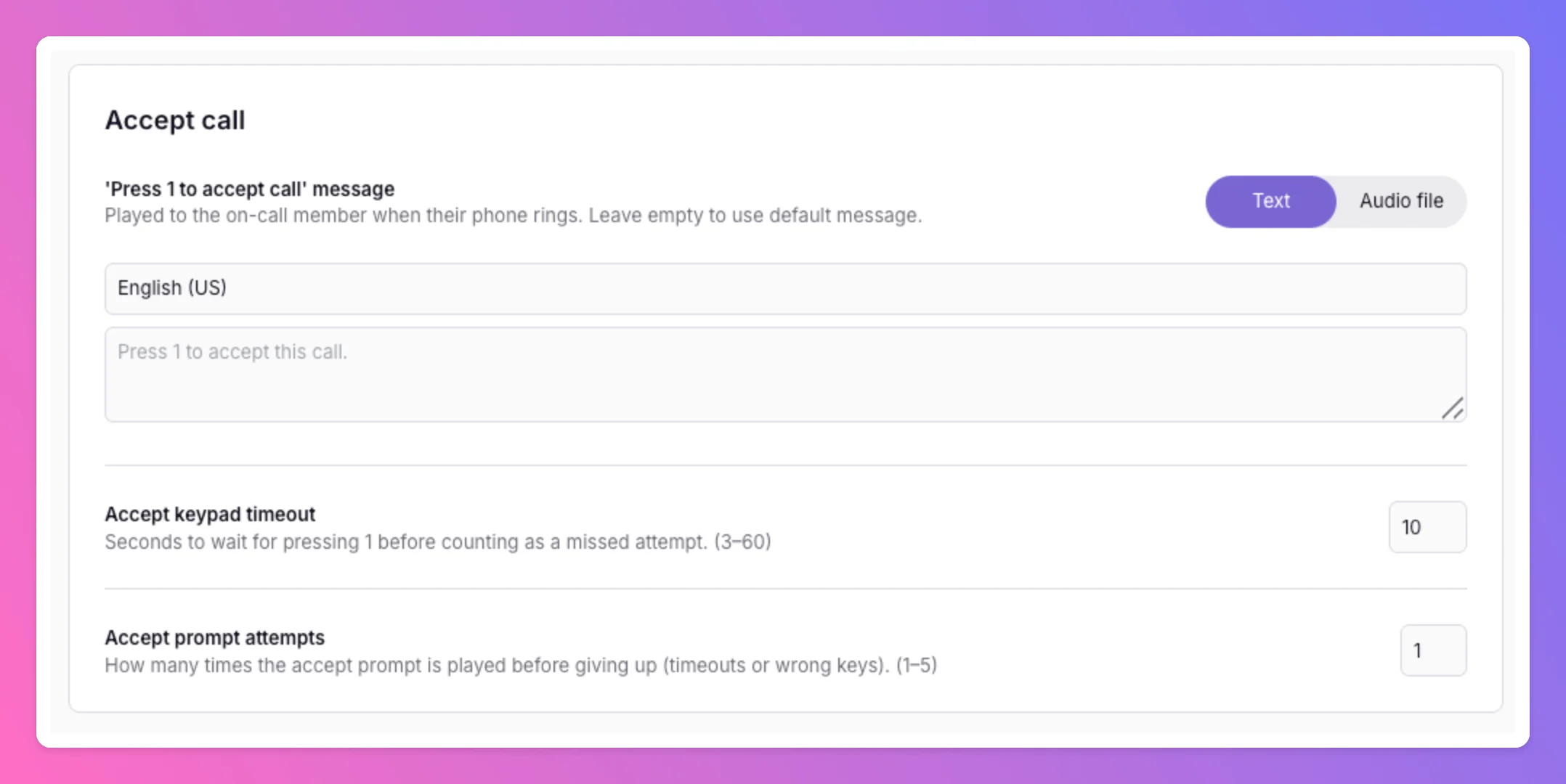
**“Press 1 to accept call” message** — The prompt played to the on-call member when their phone rings (text-to-speech or uploaded audio). They must press **1** on their keypad to accept; only then is the caller connected. Reduces accidental pickups and wrong-number answers on shared devices. Also, this prevents mailboxes from answering calls.
**Accept call keypad timeout** — How long the on-call member has to press 1 after hearing the prompt before All Quiet treats the attempt as unanswered and moves to the next person in the chain.
**Prompt attempts** — How many times the accept prompt is repeated before giving up on that person and dialing the next candidate.
Start with the defaults (max **3** users, **20** seconds per user) and adjust based on your team size and how quickly callers should reach voicemail. See [How a call flows](#how-a-call-flows) for how these settings fit into the overall call path.
#### Accept call
Before bridging the caller to an on-call member, All Quiet requires the responder to confirm they are ready to take the call.
**“Press 1 to accept call” message** — The prompt played to the on-call member when their phone rings (text-to-speech or uploaded audio). They must press **1** on their keypad to accept; only then is the caller connected. Reduces accidental pickups and wrong-number answers on shared devices. Also, this prevents mailboxes from answering calls.
**Accept call keypad timeout** — How long the on-call member has to press 1 after hearing the prompt before All Quiet treats the attempt as unanswered and moves to the next person in the chain.
**Prompt attempts** — How many times the accept prompt is repeated before giving up on that person and dialing the next candidate.
 ### Caller allow & block lists
The fourth section on the **Call Routing** tab lets you filter callers by phone number or country prefix before routing begins. Filtering runs when the call has already reached All Quiet — after your provider (e.g. Twilio) forwards it to us.
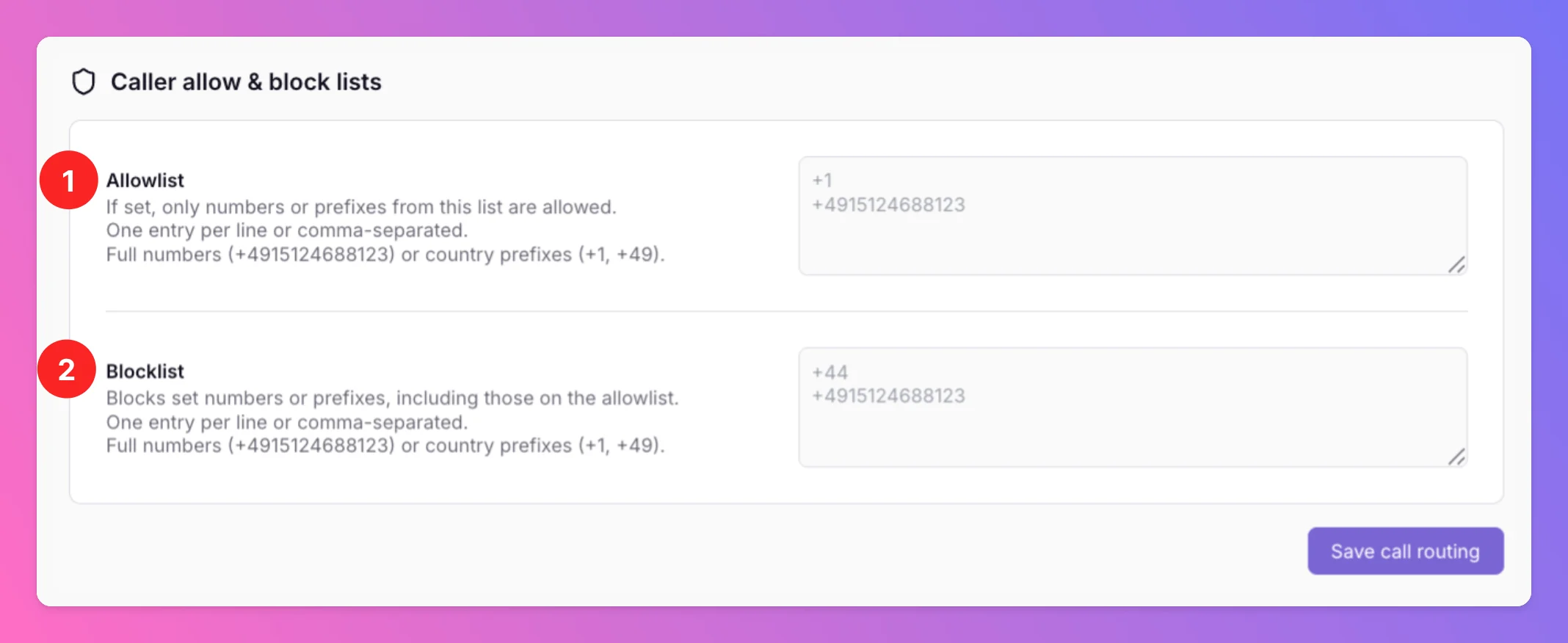
Both **Allowlist** and **Blocklist** use the same entry format:
* One entry per line or comma-separated
* Full numbers in [E.164 format](https://www.twilio.com/docs/glossary/what-e164) (for example `+4915124688123`) or country prefixes (for example `+1`, `+49`)
1. **Allowlist (Whitelist)** — If set, only callers whose number matches an entry on the allowlist (full number or prefix) are allowed through. If the allowlist is empty, all callers are allowed unless blocked by the blocklist.
2. **Blocklist** — Blocks matching numbers or prefixes. The blocklist takes precedence over the allowlist — a number that appears on both lists is blocked.
### Caller allow & block lists
The fourth section on the **Call Routing** tab lets you filter callers by phone number or country prefix before routing begins. Filtering runs when the call has already reached All Quiet — after your provider (e.g. Twilio) forwards it to us.
Both **Allowlist** and **Blocklist** use the same entry format:
* One entry per line or comma-separated
* Full numbers in [E.164 format](https://www.twilio.com/docs/glossary/what-e164) (for example `+4915124688123`) or country prefixes (for example `+1`, `+49`)
1. **Allowlist (Whitelist)** — If set, only callers whose number matches an entry on the allowlist (full number or prefix) are allowed through. If the allowlist is empty, all callers are allowed unless blocked by the blocklist.
2. **Blocklist** — Blocks matching numbers or prefixes. The blocklist takes precedence over the allowlist — a number that appears on both lists is blocked.
 All Quiet filtering runs **after** your provider accepts the call. Make sure you do not have contradictory allow/block rules in Twilio — calls only reach All Quiet if Twilio lets them through.
You've successfully set up Live Call Routing in All Quiet. You're now able to receive inbound calls and route them to the right responders.
## Operational tabs
After configuring call routing, use these tabs on your Call Routing Number to review what happened on your hotline. They complement each other: **Call Logs** capture every attempt; **Incidents** capture only what enters your on-call workflow. See [Incidents vs. call logs](#incidents-vs-call-logs) for when each applies.
### Call Logs
Call logging in All Quiet works on **two levels**:
1. **Call session** — one row per inbound call (the **Call Logs** list).
2. **Log entries** — a step-by-step timeline inside that session (**View logs**).
Every inbound call creates a session, whether or not an incident is created.
#### Call session list
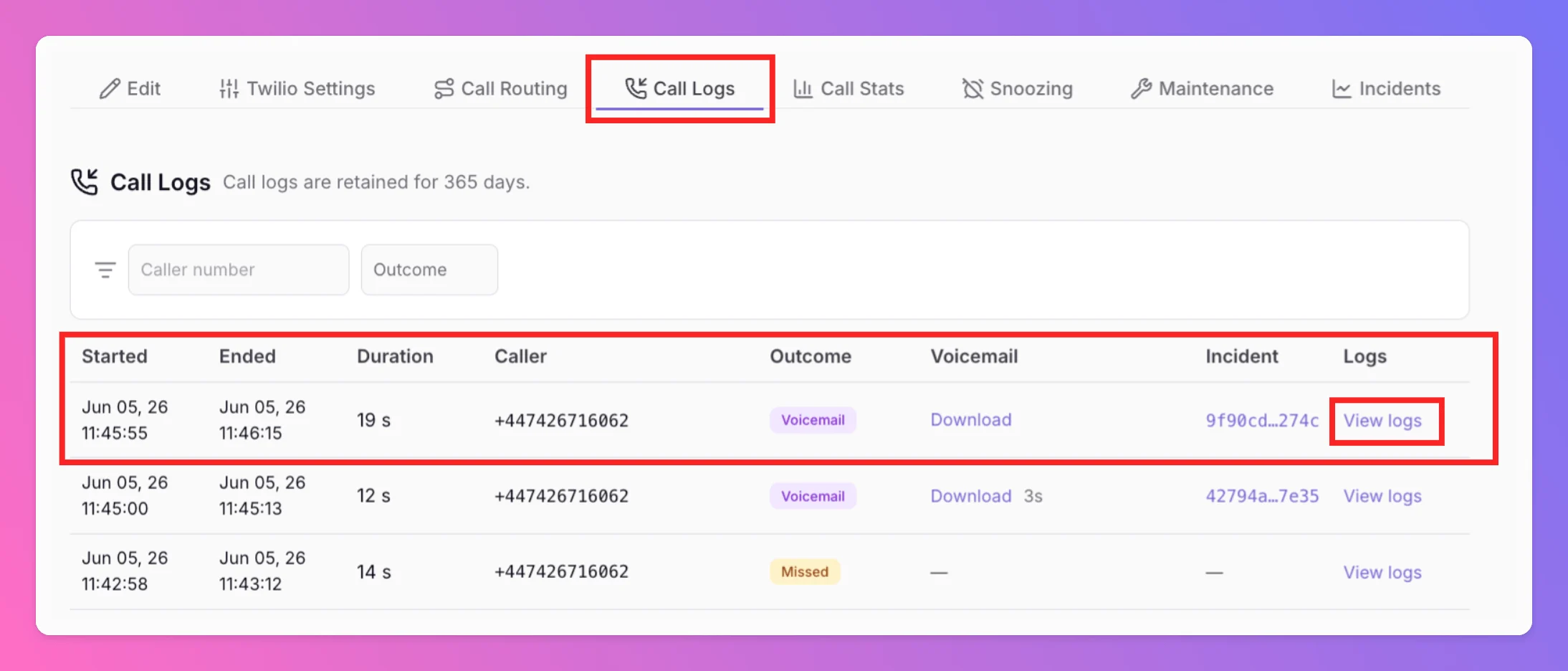
The list shows a summary for each call. You can filter by **caller number** (prefix match) and **outcome**.
| Column | What it shows |
| ------------------------------ | ----------------------------------------------------------------------------------------------------------------------------------------------------------------------------------------------- |
| **Started / Ended / Duration** | When the call began, when it finished, and total duration |
| **Caller** | The caller’s phone number |
| **Outcome** | Final result badge — see [Session outcomes](#session-outcomes) below |
| **Voicemail** | Download link if a recording was captured |
| **Incident** | Link to the incident, if one was created — from the incident, open **[Call Logs](/essentials/incident#incident-details-call-logs)** in the Properties sidebar for the same session and timeline |
| **Logs** | Opens the [detailed timeline](#view-logs-session-detail) for that call |
All Quiet filtering runs **after** your provider accepts the call. Make sure you do not have contradictory allow/block rules in Twilio — calls only reach All Quiet if Twilio lets them through.
You've successfully set up Live Call Routing in All Quiet. You're now able to receive inbound calls and route them to the right responders.
## Operational tabs
After configuring call routing, use these tabs on your Call Routing Number to review what happened on your hotline. They complement each other: **Call Logs** capture every attempt; **Incidents** capture only what enters your on-call workflow. See [Incidents vs. call logs](#incidents-vs-call-logs) for when each applies.
### Call Logs
Call logging in All Quiet works on **two levels**:
1. **Call session** — one row per inbound call (the **Call Logs** list).
2. **Log entries** — a step-by-step timeline inside that session (**View logs**).
Every inbound call creates a session, whether or not an incident is created.
#### Call session list
The list shows a summary for each call. You can filter by **caller number** (prefix match) and **outcome**.
| Column | What it shows |
| ------------------------------ | ----------------------------------------------------------------------------------------------------------------------------------------------------------------------------------------------- |
| **Started / Ended / Duration** | When the call began, when it finished, and total duration |
| **Caller** | The caller’s phone number |
| **Outcome** | Final result badge — see [Session outcomes](#session-outcomes) below |
| **Voicemail** | Download link if a recording was captured |
| **Incident** | Link to the incident, if one was created — from the incident, open **[Call Logs](/essentials/incident#incident-details-call-logs)** in the Properties sidebar for the same session and timeline |
| **Logs** | Opens the [detailed timeline](#view-logs-session-detail) for that call |
 #### Session outcomes
These badges answer **“What happened to this call?”**
| Outcome | Meaning |
| --------------- | ------------------------------------------------------------------------------------------------------------------------------------------------------------------------------------------------------------------------- |
| **Ongoing** | The call has not finished yet. |
| **Accepted** | An on-call member answered **and pressed 1 to accept**; the call was bridged to the caller. Picking up without pressing 1 does **not** count as Accepted. |
| **Voicemail** | The caller left a voicemail — either via [direct voicemail](/advanced/live-call-routing#caller-fallback) or after no one responded with voicemail fallback enabled. |
| **Missed** | The call ended without anyone accepting and without a voicemail recording — for example dial chain exhausted with only a [closing message](/advanced/live-call-routing#caller-fallback). |
| **Blocklisted** | Caller was rejected by the [allow/block list](#caller-allow-%26-block-lists) before routing. No welcome message, no on-call dial, no incident. Log step: `CallerBlocklisted`. |
| **Failed** | Reserved for sessions explicitly marked as failed. Most calls resolve to **Accepted**, **Voicemail**, or **Missed** instead. You might want to check your provider (e.g. Twilio) logs as well to see why the call failed. |
#### View logs (session detail)
Click **View logs** on a session to open:
1. **Session summary** — caller, outcome, timestamps, provider call ID, voicemail download (if any).
2. **Chronological log table** — one row per processing step: webhook received, dial chain built, dial attempt, voice command sent, and so on.
#### Session outcomes
These badges answer **“What happened to this call?”**
| Outcome | Meaning |
| --------------- | ------------------------------------------------------------------------------------------------------------------------------------------------------------------------------------------------------------------------- |
| **Ongoing** | The call has not finished yet. |
| **Accepted** | An on-call member answered **and pressed 1 to accept**; the call was bridged to the caller. Picking up without pressing 1 does **not** count as Accepted. |
| **Voicemail** | The caller left a voicemail — either via [direct voicemail](/advanced/live-call-routing#caller-fallback) or after no one responded with voicemail fallback enabled. |
| **Missed** | The call ended without anyone accepting and without a voicemail recording — for example dial chain exhausted with only a [closing message](/advanced/live-call-routing#caller-fallback). |
| **Blocklisted** | Caller was rejected by the [allow/block list](#caller-allow-%26-block-lists) before routing. No welcome message, no on-call dial, no incident. Log step: `CallerBlocklisted`. |
| **Failed** | Reserved for sessions explicitly marked as failed. Most calls resolve to **Accepted**, **Voicemail**, or **Missed** instead. You might want to check your provider (e.g. Twilio) logs as well to see why the call failed. |
#### View logs (session detail)
Click **View logs** on a session to open:
1. **Session summary** — caller, outcome, timestamps, provider call ID, voicemail download (if any).
2. **Chronological log table** — one row per processing step: webhook received, dial chain built, dial attempt, voice command sent, and so on.
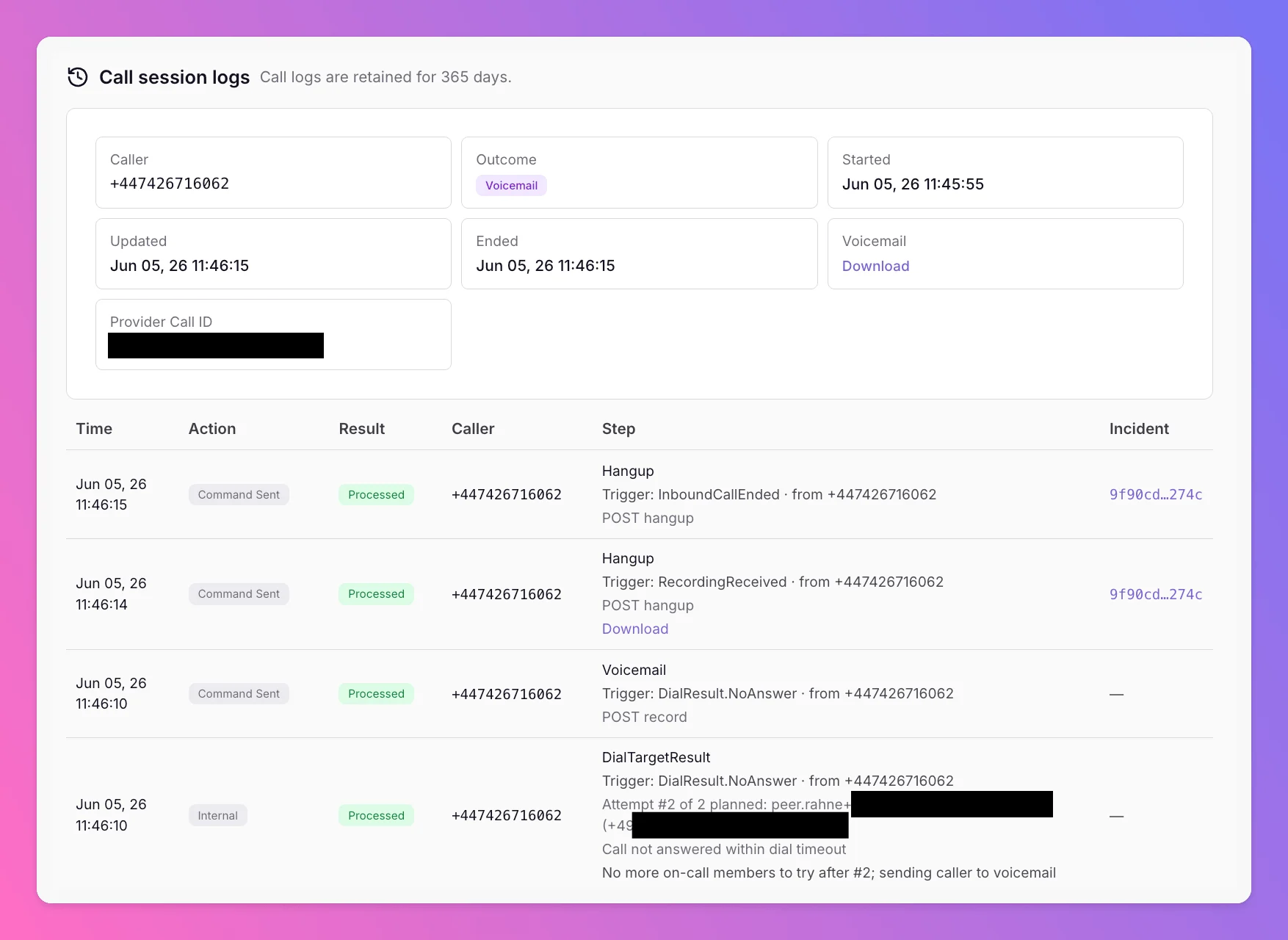 Use this view when troubleshooting routing — for example “Why wasn’t person X rung?” or “Why did this call go to voicemail after only one attempt?”
#### Reading the log timeline
Each log row has a **Step** (where the call was in the flow), an **Action**, and a **Result**. The most useful steps when reading a call:
| Step | When it appears |
| ------------------------------------------- | -------------------------------------------------------------------------------------------------------------------------------------------------------------- |
| **CallReceived** | A new inbound call arrived; the session was created. |
| **CallerBlocklisted** | Caller failed the [allow/block check](#caller-allow-%26-block-lists). Call ended immediately; no further routing steps are logged. |
| **GatherDtmf** | Waiting for the caller to press a menu key ([keypad menu mode](/advanced/live-call-routing#keypad-menu-mode)). |
| **DialChainResolved** | All Quiet computed who will be dialed and in what order. **Start here** to see the full on-call dial list. |
| **DialTarget** | About to ring an on-call member. |
| **DialTargetResult** | Result of that dial attempt — explains in plain language why it succeeded or failed (timeout, busy, answered but did not press 1, accepted and bridged, etc.). |
| **ConfirmTarget** / **ConfirmTargetResult** | The on-call member heard the “press 1 to accept” prompt and their response. |
| **Voicemail** / **RecordMessage** | Caller was sent to voicemail or is recording a message. |
| **Hangup** | Call is ending (closing message or clean hang-up). |
**Actions** on each row:
| Action | Meaning |
| -------------------- | ------------------------------------------------------------------------------------------- |
| **Webhook Received** | Your provider (Twilio) sent a status update. |
| **Command Sent** | All Quiet sent a voice command back (play prompt, dial, gather keypad input, etc.). |
| **Internal** | Internal processing only — for example resolving the dial chain or analyzing a dial result. |
**Results:** **Processed** (step handled), **Failed** (something went wrong — see error details in the row), or **Ignored** (webhook received but no action taken).
A log row with **Result = Failed** is not the same as session outcome **Failed**. A single failed processing step can still end with the call marked **Missed** or **Voicemail**.
When debugging a call, read **DialChainResolved** first (who was eligible), then each **DialTargetResult** (what happened per attempt), then **Voicemail** or **Hangup** (how the call ended).
#### Retention
| Data | Retention |
| ---------------------------------------------------- | -------------------------------------------------------------------------- |
| **Detailed log entries** (timeline in **View logs**) | **365 days** — shown in the UI as “Call logs are retained for 365 days.” |
| **Voicemail recordings** | **365 days** — download links stop working after the recording is removed. |
| **Call session summaries** (list rows) | Kept for 365 days automatic expiry |
When a caller reports they couldn’t get through but no incident was created, check **Call Logs** first. Missed calls, exhausted dial chains, and calls during maintenance all appear here — but not in the **Incidents** tab.
### Call Stats
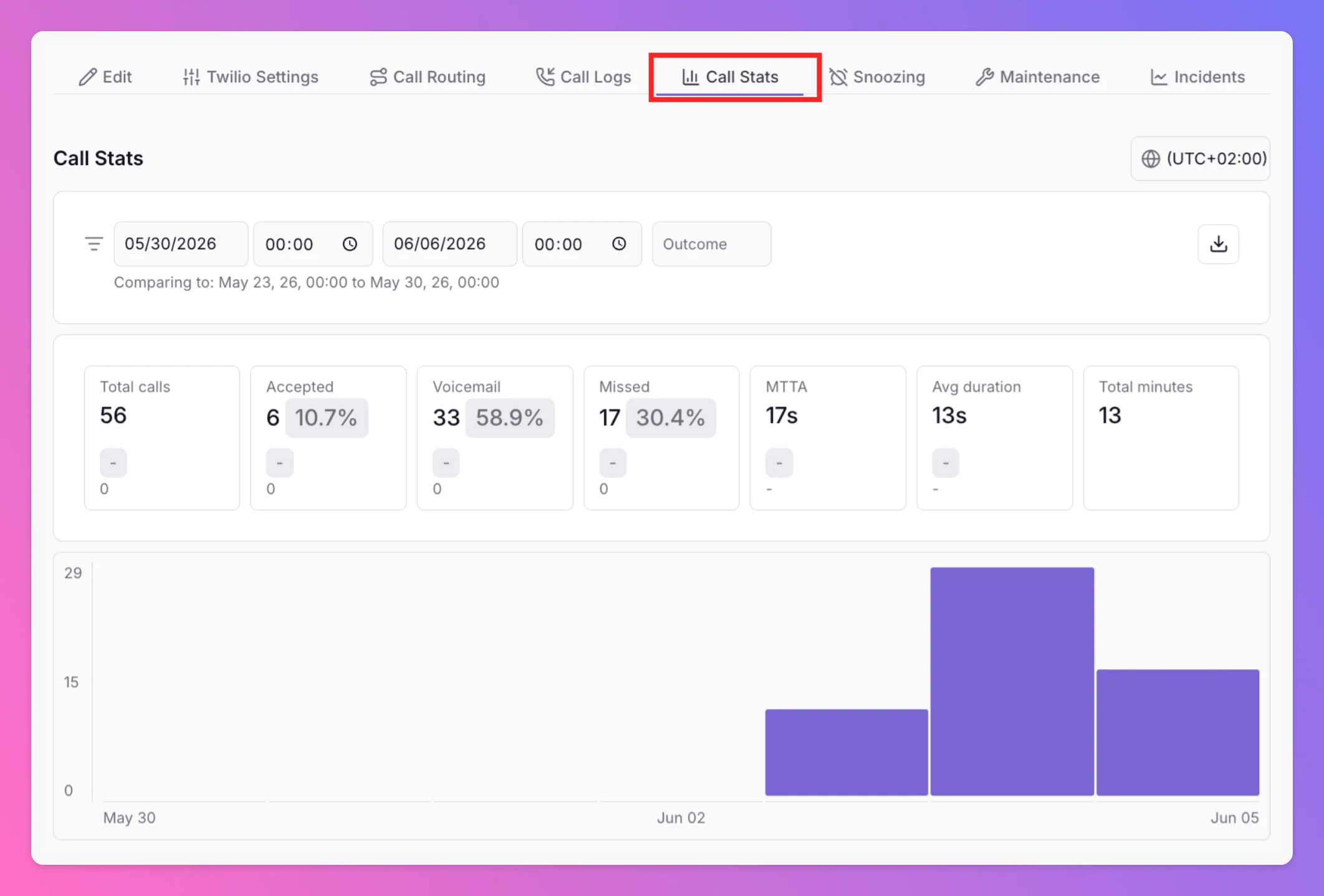
**Call Stats** aggregates call sessions on this number over time — volume, duration, and breakdown by **outcome** (**Accepted**, **Voicemail**, **Missed**, **Blocklisted**, **Ongoing**, and **Failed**). Use it to spot trends: Are most callers reaching a responder? How often does voicemail kick in? Is missed-call volume rising after a schedule change? How many callers are being rejected by your allow/block lists?
The same outcome badges from the [Call Logs](#session-outcomes) list drive these statistics, so numbers in **Call Stats** match what you see per call in **Call Logs**.
Call logs are retained for 2 years.
Use this view when troubleshooting routing — for example “Why wasn’t person X rung?” or “Why did this call go to voicemail after only one attempt?”
#### Reading the log timeline
Each log row has a **Step** (where the call was in the flow), an **Action**, and a **Result**. The most useful steps when reading a call:
| Step | When it appears |
| ------------------------------------------- | -------------------------------------------------------------------------------------------------------------------------------------------------------------- |
| **CallReceived** | A new inbound call arrived; the session was created. |
| **CallerBlocklisted** | Caller failed the [allow/block check](#caller-allow-%26-block-lists). Call ended immediately; no further routing steps are logged. |
| **GatherDtmf** | Waiting for the caller to press a menu key ([keypad menu mode](/advanced/live-call-routing#keypad-menu-mode)). |
| **DialChainResolved** | All Quiet computed who will be dialed and in what order. **Start here** to see the full on-call dial list. |
| **DialTarget** | About to ring an on-call member. |
| **DialTargetResult** | Result of that dial attempt — explains in plain language why it succeeded or failed (timeout, busy, answered but did not press 1, accepted and bridged, etc.). |
| **ConfirmTarget** / **ConfirmTargetResult** | The on-call member heard the “press 1 to accept” prompt and their response. |
| **Voicemail** / **RecordMessage** | Caller was sent to voicemail or is recording a message. |
| **Hangup** | Call is ending (closing message or clean hang-up). |
**Actions** on each row:
| Action | Meaning |
| -------------------- | ------------------------------------------------------------------------------------------- |
| **Webhook Received** | Your provider (Twilio) sent a status update. |
| **Command Sent** | All Quiet sent a voice command back (play prompt, dial, gather keypad input, etc.). |
| **Internal** | Internal processing only — for example resolving the dial chain or analyzing a dial result. |
**Results:** **Processed** (step handled), **Failed** (something went wrong — see error details in the row), or **Ignored** (webhook received but no action taken).
A log row with **Result = Failed** is not the same as session outcome **Failed**. A single failed processing step can still end with the call marked **Missed** or **Voicemail**.
When debugging a call, read **DialChainResolved** first (who was eligible), then each **DialTargetResult** (what happened per attempt), then **Voicemail** or **Hangup** (how the call ended).
#### Retention
| Data | Retention |
| ---------------------------------------------------- | -------------------------------------------------------------------------- |
| **Detailed log entries** (timeline in **View logs**) | **365 days** — shown in the UI as “Call logs are retained for 365 days.” |
| **Voicemail recordings** | **365 days** — download links stop working after the recording is removed. |
| **Call session summaries** (list rows) | Kept for 365 days automatic expiry |
When a caller reports they couldn’t get through but no incident was created, check **Call Logs** first. Missed calls, exhausted dial chains, and calls during maintenance all appear here — but not in the **Incidents** tab.
### Call Stats
**Call Stats** aggregates call sessions on this number over time — volume, duration, and breakdown by **outcome** (**Accepted**, **Voicemail**, **Missed**, **Blocklisted**, **Ongoing**, and **Failed**). Use it to spot trends: Are most callers reaching a responder? How often does voicemail kick in? Is missed-call volume rising after a schedule change? How many callers are being rejected by your allow/block lists?
The same outcome badges from the [Call Logs](#session-outcomes) list drive these statistics, so numbers in **Call Stats** match what you see per call in **Call Logs**.
Call logs are retained for 2 years.
 ### Incident Report
The [Integration-level Incident Report](/advanced/report#integration-level) shows [incidents](/essentials/incident) **created from this number** — not every call. Only **voicemails** and **successfully accepted calls** produce incidents; **Missed** outcomes appear in **Call Logs** only.
### What snoozing, maintenance, and mute do (and don’t do)
This section clarifies a common misconception: these controls only **affect incindents** resulting from Calls, but not the call routing itself.
| Control | Affects live calls? | Affects incidents? |
| ---------------------------- | --------------------------------- | -------------------------------------------------------------------------------------------------------------------------------------------------------------------- |
| **Snoozing** | No — calls still route to on-call | New incidents create after the call ends or voicemail is left can be [snoozed](/essentials/inbound#snoozing-inbound-integrations); call routing itself is unaffected |
| **Maintenance** | No — calls still route | **New incident creation is suppressed** during maintenance windows; the call still happens, but you will not get an incident record |
| **Muted** | No | Affects [incident/notification behavior](/essentials/inbound#maintenance-for-inbound-integrations), not the inbound call path |
| **Pausing the phone number** | **Not in All Quiet** | N/A |
#### Pausing or disabling the number in Twilio
All Quiet has no “pause this number” toggle for Call Routing Numbers (unlike [Ping Monitor](/integrations/inbound/ping-monitor) or [HTTP Monitoring](/integrations/inbound/website-http-monitoring)). To temporarily stop callers from reaching All Quiet, adjust the webhook in **Twilio Console**:
**Temporarily pause inbound calls (keep the number)**
1. Open [Twilio Console](https://console.twilio.com/) → **Phone Numbers** → **Manage** → **Active numbers** and select your Live Call Routing number.
2. Under **Voice configuration**, find **A call comes in** (also labeled **Incoming Voice Call**).
3. Replace the All Quiet webhook with one of the following:
* A **TwiML Bin** or **TwiML App** that plays a short “this line is unavailable” message and hangs up.
* A **Twilio Function** that rejects the call (``).
* Clear or change the webhook so traffic no longer reaches All Quiet.
Callers will no longer enter the All Quiet routing flow until you restore the webhook.
**Resume routing to All Quiet**
When you are ready to go live again, make sure there's no webhook configured in Twilio Console in **A call comes in** for your number. Then, open the **Twilio Settings** tab on your Call Routing Number in All Quiet and **save** your integration settings. All Quiet re-applies the correct voice webhook on your Twilio number. Confirm under **A call comes in** in Twilio Console that the webhook points back to All Quiet, then place a test call.
## Recommended defaults & tuning guide
A practical “start here” table:
| Scenario | Suggested settings |
| ----------------------------- | ------------------------------------------------------------------------------------------------------------------------- |
| Small team, single hotline | Single route, max users = tier count, voicemail on, auto-resolve on |
| High concurrent caller volume | Voicemail on, reasonable max users (3–5), accept-call enabled — see [Concurrent inbound calls](#concurrent-inbound-calls) |
| After-hours only voicemail | Direct voicemail route, or schedule via team availability |
| Multi-department | Keypad menu, one route per team |
## Troubleshooting
### Can I buy a phone number through All Quiet?
**Not currently.** Live Call Routing uses **Bring Your Own Number (BYON)**: you purchase and own the number with a provider such as [Twilio](/integrations/inbound/twilio), then connect it to All Quiet. We do this so you are not charged twice — once by the carrier for the number and again by All Quiet on top. You pay your provider directly for the number and usage; All Quiet handles routing and on-call dialing on top.
### Can All Quiet create incidents for missed calls?
**No.** All Quiet only creates incidents for **voicemails** and **accepted calls** (on-call member pressed 1 and the call was bridged). **Missed** calls — where no one accepts and the caller does not leave voicemail — appear in **Call Logs** only, not in **Incidents**.
If you want a record that enters your escalations when no one answers, enable **[Send to voicemail if no one responds](/advanced/live-call-routing#caller-fallback)** or **[Send caller directly to voicemail](/advanced/live-call-routing#caller-fallback)** on your route. Voicemail recordings create **open incidents**. See [Incidents vs. call logs](/advanced/live-call-routing#incidents-vs-call-logs).
### Call connects but no incident was created
The call was routed and appears in **Call Logs**, but no incident was created. Check whether a [maintenance window](/essentials/inbound#maintenance-for-inbound-integrations) was active — calls still route, but incident creation is suppressed. See [Incidents vs. call logs](/advanced/live-call-routing#incidents-vs-call-logs).
### Nobody gets rung when someone calls the hotline
Verify that on-call members are **online**, have a **confirmed phone number** on their profile, and that the route’s **Team to route to** is correct. Call routing only dials members in that team’s on-call schedule. See [Prerequisites](/advanced/live-call-routing#prerequisites) and [On-call chain & dialing](/advanced/live-call-routing#how-a-call-flows).
### The same person always seems to be rung first
Within a tier, dial order is **shuffled randomly per call** — there is no fixed “first responder.” The same person may be tried first several times in a row by chance; across many calls the order varies.
### A second simultaneous caller always gets voicemail
[Expected when all reachable numbers are busy](/advanced/live-call-routing#concurrent-inbound-calls). On-call members already on a live call for that team are excluded from other dial chains. Enable **Send to voicemail if no one responds** so concurrent callers can leave a message.
### The number still receives calls after “pausing” in All Quiet
All Quiet has no pause toggle for Call Routing Numbers. Pause or disable inbound calls in **Twilio** — see [Pausing or disabling the number in Twilio](/advanced/live-call-routing#pausing-or-disabling-the-number-in-twilio).
## Related docs
* [Connect Twilio with All Quiet](/integrations/inbound/twilio) — number setup and credentials
* [On-call schedules & escalation tiers](/essentials/escalations)
* [Troubleshooting & FAQs — Live Call Routing](/miscellaneous/troubleshooting#live-call-routing)
### Incident Report
The [Integration-level Incident Report](/advanced/report#integration-level) shows [incidents](/essentials/incident) **created from this number** — not every call. Only **voicemails** and **successfully accepted calls** produce incidents; **Missed** outcomes appear in **Call Logs** only.
### What snoozing, maintenance, and mute do (and don’t do)
This section clarifies a common misconception: these controls only **affect incindents** resulting from Calls, but not the call routing itself.
| Control | Affects live calls? | Affects incidents? |
| ---------------------------- | --------------------------------- | -------------------------------------------------------------------------------------------------------------------------------------------------------------------- |
| **Snoozing** | No — calls still route to on-call | New incidents create after the call ends or voicemail is left can be [snoozed](/essentials/inbound#snoozing-inbound-integrations); call routing itself is unaffected |
| **Maintenance** | No — calls still route | **New incident creation is suppressed** during maintenance windows; the call still happens, but you will not get an incident record |
| **Muted** | No | Affects [incident/notification behavior](/essentials/inbound#maintenance-for-inbound-integrations), not the inbound call path |
| **Pausing the phone number** | **Not in All Quiet** | N/A |
#### Pausing or disabling the number in Twilio
All Quiet has no “pause this number” toggle for Call Routing Numbers (unlike [Ping Monitor](/integrations/inbound/ping-monitor) or [HTTP Monitoring](/integrations/inbound/website-http-monitoring)). To temporarily stop callers from reaching All Quiet, adjust the webhook in **Twilio Console**:
**Temporarily pause inbound calls (keep the number)**
1. Open [Twilio Console](https://console.twilio.com/) → **Phone Numbers** → **Manage** → **Active numbers** and select your Live Call Routing number.
2. Under **Voice configuration**, find **A call comes in** (also labeled **Incoming Voice Call**).
3. Replace the All Quiet webhook with one of the following:
* A **TwiML Bin** or **TwiML App** that plays a short “this line is unavailable” message and hangs up.
* A **Twilio Function** that rejects the call (``).
* Clear or change the webhook so traffic no longer reaches All Quiet.
Callers will no longer enter the All Quiet routing flow until you restore the webhook.
**Resume routing to All Quiet**
When you are ready to go live again, make sure there's no webhook configured in Twilio Console in **A call comes in** for your number. Then, open the **Twilio Settings** tab on your Call Routing Number in All Quiet and **save** your integration settings. All Quiet re-applies the correct voice webhook on your Twilio number. Confirm under **A call comes in** in Twilio Console that the webhook points back to All Quiet, then place a test call.
## Recommended defaults & tuning guide
A practical “start here” table:
| Scenario | Suggested settings |
| ----------------------------- | ------------------------------------------------------------------------------------------------------------------------- |
| Small team, single hotline | Single route, max users = tier count, voicemail on, auto-resolve on |
| High concurrent caller volume | Voicemail on, reasonable max users (3–5), accept-call enabled — see [Concurrent inbound calls](#concurrent-inbound-calls) |
| After-hours only voicemail | Direct voicemail route, or schedule via team availability |
| Multi-department | Keypad menu, one route per team |
## Troubleshooting
### Can I buy a phone number through All Quiet?
**Not currently.** Live Call Routing uses **Bring Your Own Number (BYON)**: you purchase and own the number with a provider such as [Twilio](/integrations/inbound/twilio), then connect it to All Quiet. We do this so you are not charged twice — once by the carrier for the number and again by All Quiet on top. You pay your provider directly for the number and usage; All Quiet handles routing and on-call dialing on top.
### Can All Quiet create incidents for missed calls?
**No.** All Quiet only creates incidents for **voicemails** and **accepted calls** (on-call member pressed 1 and the call was bridged). **Missed** calls — where no one accepts and the caller does not leave voicemail — appear in **Call Logs** only, not in **Incidents**.
If you want a record that enters your escalations when no one answers, enable **[Send to voicemail if no one responds](/advanced/live-call-routing#caller-fallback)** or **[Send caller directly to voicemail](/advanced/live-call-routing#caller-fallback)** on your route. Voicemail recordings create **open incidents**. See [Incidents vs. call logs](/advanced/live-call-routing#incidents-vs-call-logs).
### Call connects but no incident was created
The call was routed and appears in **Call Logs**, but no incident was created. Check whether a [maintenance window](/essentials/inbound#maintenance-for-inbound-integrations) was active — calls still route, but incident creation is suppressed. See [Incidents vs. call logs](/advanced/live-call-routing#incidents-vs-call-logs).
### Nobody gets rung when someone calls the hotline
Verify that on-call members are **online**, have a **confirmed phone number** on their profile, and that the route’s **Team to route to** is correct. Call routing only dials members in that team’s on-call schedule. See [Prerequisites](/advanced/live-call-routing#prerequisites) and [On-call chain & dialing](/advanced/live-call-routing#how-a-call-flows).
### The same person always seems to be rung first
Within a tier, dial order is **shuffled randomly per call** — there is no fixed “first responder.” The same person may be tried first several times in a row by chance; across many calls the order varies.
### A second simultaneous caller always gets voicemail
[Expected when all reachable numbers are busy](/advanced/live-call-routing#concurrent-inbound-calls). On-call members already on a live call for that team are excluded from other dial chains. Enable **Send to voicemail if no one responds** so concurrent callers can leave a message.
### The number still receives calls after “pausing” in All Quiet
All Quiet has no pause toggle for Call Routing Numbers. Pause or disable inbound calls in **Twilio** — see [Pausing or disabling the number in Twilio](/advanced/live-call-routing#pausing-or-disabling-the-number-in-twilio).
## Related docs
* [Connect Twilio with All Quiet](/integrations/inbound/twilio) — number setup and credentials
* [On-call schedules & escalation tiers](/essentials/escalations)
* [Troubleshooting & FAQs — Live Call Routing](/miscellaneous/troubleshooting#live-call-routing)